
A report titled "Foreign Trade GEO Semantic Optimization Trend Report" released by OpenAI and Semrush in February 2026 revealed that 83% of independent foreign trade websites were still trapped in the GEO (Generative Engine Optimization) pitfall of "keyword stuffing"—repeatedly piling up keywords such as "foreign trade," "export," "compliance," and "MOQ" on their pages. The content was stiff, redundant, and logically disjointed. Even if the keyword density met the standards, these websites were unlikely to be prioritized by AI platforms like ChatGPT and were instead judged as "low-quality optimization," leading to decreased site exposure and lower site ranking. In contrast, foreign trade websites that adopted semantic optimization, without deliberately stuffing keywords, saw an average increase of 68% in AI crawling rate, content citation rate, and accurate inquiry volume. The core reason lies in the continuous upgrading of AI's semantic understanding capabilities. By 2026, AI no longer relied on keyword density to judge content value but instead focused more on the semantic logic, core value, and the matching degree between the content and the needs of buyers. In fact, the core of GEO optimization is not "making AI see keywords", but "making AI understand core value". Only by doing a good job of semantic optimization, making the semantic logic of content, signals and pages coherent and consistent, and conforming to the rules of AI semantic understanding, can we achieve AI priority crawling and accurate exposure without stuffing keywords, and create a foreign trade independent website with core competitiveness.
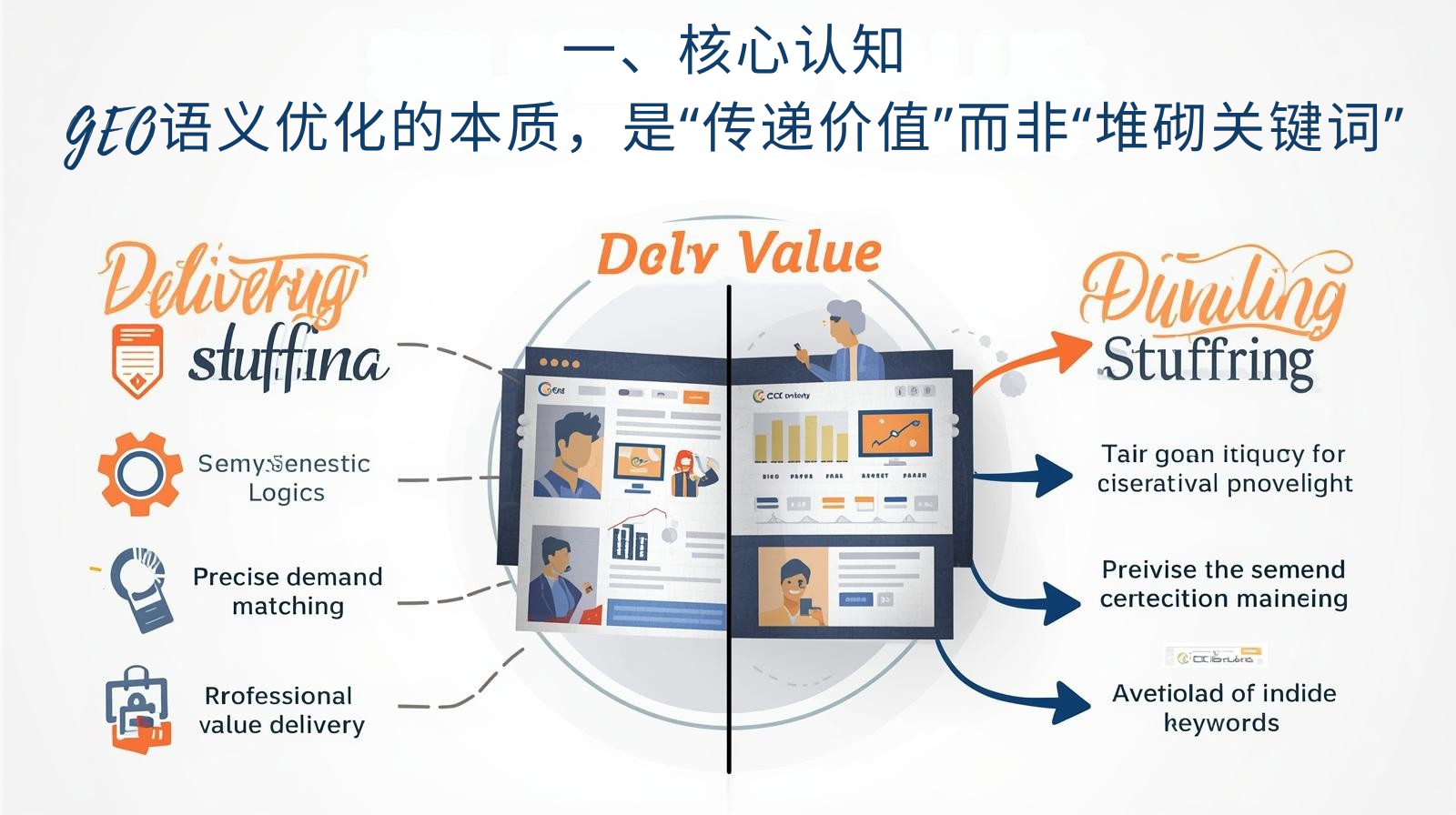
I. Core Understanding: The essence of GEO semantic optimization is "delivering value" rather than "keyword stuffing".
Many foreign trade websites have misconceptions about GEO semantic optimization, believing that "semantic optimization is just another way of stuffing keywords" and "without keyword stuffing, AI can't recognize it." This is not the case. The essence of GEO semantic optimization is to enable AI to quickly understand the website's core positioning, product advantages, and content value through clear semantic logic, accurate demand matching, and professional value delivery, while simultaneously aligning with the search intent of foreign trade buyers, achieving the dual goals of "AI understanding and buyer approval." Compared to keyword stuffing, it emphasizes "logical coherence, clear value, and demand matching," which perfectly aligns with the core iterative direction of AI semantic understanding in 2026—AI should be able to identify the core meaning and value of content through contextual association, rather than simply relying on isolated keywords. Referencing OpenAI's "AI Semantic Understanding Evaluation Guidelines" released in February 2026 (link: https://platform.openai.com/docs/guides/generative-search/ai-semantic-understanding), it explicitly includes "semantic logical coherence" and "clarity of core value" as core indicators for AI crawling evaluation, with a weight far exceeding keyword density.
1.1 The core differences between keyword stuffing and GEO semantic optimization (specifically for foreign trade scenarios)
To truly eliminate the pitfalls of keyword stuffing and establish a correct understanding of semantic optimization, it's crucial to understand the core differences between the two approaches. This will prevent wasting time and resources and ensure that the key differences are relevant to the actual practice of GEO optimization in foreign trade. The key differences are clear, easy to understand, and actionable: ① Different Core Logic: Keyword stuffing focuses on "making AI see the keywords," ignoring content logic and user experience by repeating keywords in isolation. For example, repeatedly piling up "foreign trade toys," "EU compliant toys," and "toy MOQ" on product pages results in content lacking real value. Semantic optimization, on the other hand, focuses on "making AI understand the core value," naturally integrating keywords into content, signals, and pages. Through coherent semantic logic, it conveys the site's product advantages, solutions, and core value. For example, it naturally integrates relevant keywords around the core value of "small-batch compliant export of toys by small and medium-sized foreign trade enterprises," resulting in a coherent logic and clear value. ② Content presentation differs: Keyword stuffing results in stiff, redundant, and illogical content lacking professionalism and readability, failing to address buyers' actual pain points and even causing grammatical inconsistencies due to keyword stuffing; semantically optimized content, on the other hand, is logically coherent, professional, and fluent, focusing on buyers' pain points (such as compliance issues and excessively high MOQs), providing actionable solutions, and is highly readable. It also allows AI to quickly identify the core content and site value through context. ③ AI recognition effects differ: Keyword stuffing is judged as "low-quality optimization" by AI, resulting in extremely low crawling and citation rates, and may even lower site ranking, making it difficult to gain effective exposure; semantically optimized content is quickly identified by AI as "high-value content," prioritized for crawling and citation, and accurately matches buyers' semantic search intent, improving exposure accuracy. Refer to Ahrefs' 2026 foreign trade site AI recognition data (link: https://ahrefs.com/blog/2026-ai-semantic-recognition/). ④ The long-term value differs: Keyword stuffing cannot accumulate site value. Once the AI crawling rules change, site exposure will drop instantly and become unsustainable. Semantic optimization, on the other hand, can accumulate the site's core value and brand authority. Even if the AI rules change, it can maintain stable AI recognition and achieve long-term sustainable exposure and conversion.
1.2 Three Core Features of AI Semantic Understanding in 2026 (Essential for Foreign Trade Websites)
The prerequisite for effective GEO semantic optimization is understanding the core characteristics of AI semantic understanding in 2026 and aligning with AI's recognition logic. This ensures precise and effective optimization, avoiding "self-indulgent optimization." Three key characteristics align with foreign trade procurement scenarios and GEO optimization needs: ① Contextual Recognition: AI no longer identifies individual keywords in isolation but understands the core meaning through the context of content, signals, and pages. For example, when AI sees "2026 EU CE certification process," it will combine the subsequent practical steps and required materials to determine that the core content is "CE certification solution," rather than simply recognizing the keyword "CE certification." ② Demand Intent Matching: AI can accurately identify the semantic search intent of buyers and match corresponding site value based on the foreign trade procurement scenario. For example, if a buyer searches for "how small and medium-sized foreign trade enterprises can export in compliance with low costs," AI will prioritize recommending sites semantically aligned with "low-cost compliance solutions," rather than sites piling up "compliance" keywords. ③ Value Priority Identification: AI will prioritize identifying sites and content with "clear core value," such as "a foreign trade toy supplier focusing on small-batch customization, low-cost and compliant services." These are more likely to be recognized by AI than sites with no clear value, such as "foreign trade toys," "export toys," or "compliant toys." See the Global Sources 2026 Foreign Trade Procurement Semantic Search Report (link: https://www.globalources.com/industry-report/2026-semantic-search).
1.3 Core Objectives of GEO Semantic Optimization (Specifically for Foreign Trade Scenarios)
The core objective of GEO semantic optimization for independent foreign trade websites is not "improving keyword rankings," but rather achieving three core goals: aligning with the AI ecosystem and buyer needs, while balancing short-term exposure and long-term value: ① Enabling AI to quickly understand the website's core positioning: Clearly conveying the website's product categories and core advantages (such as small-batch customization, low-cost compliance, and fast delivery), allowing AI to clearly understand "what value your website can provide to buyers"; ② Enabling AI to accurately match buyers' semantic needs: Aligning with the semantic search habits of foreign trade buyers (such as question-and-answer style and demand-based search), ensuring the website is prioritized and recommended by AI when buyers search for relevant semantics; ③ Enabling AI to recognize the website's professional value: Through coherent semantic logic, professional content output, and clear value delivery, enabling AI to classify the website as a "high-value foreign trade website," increasing website authority and AI citation rate, laying the foundation for long-term exposure and conversion.
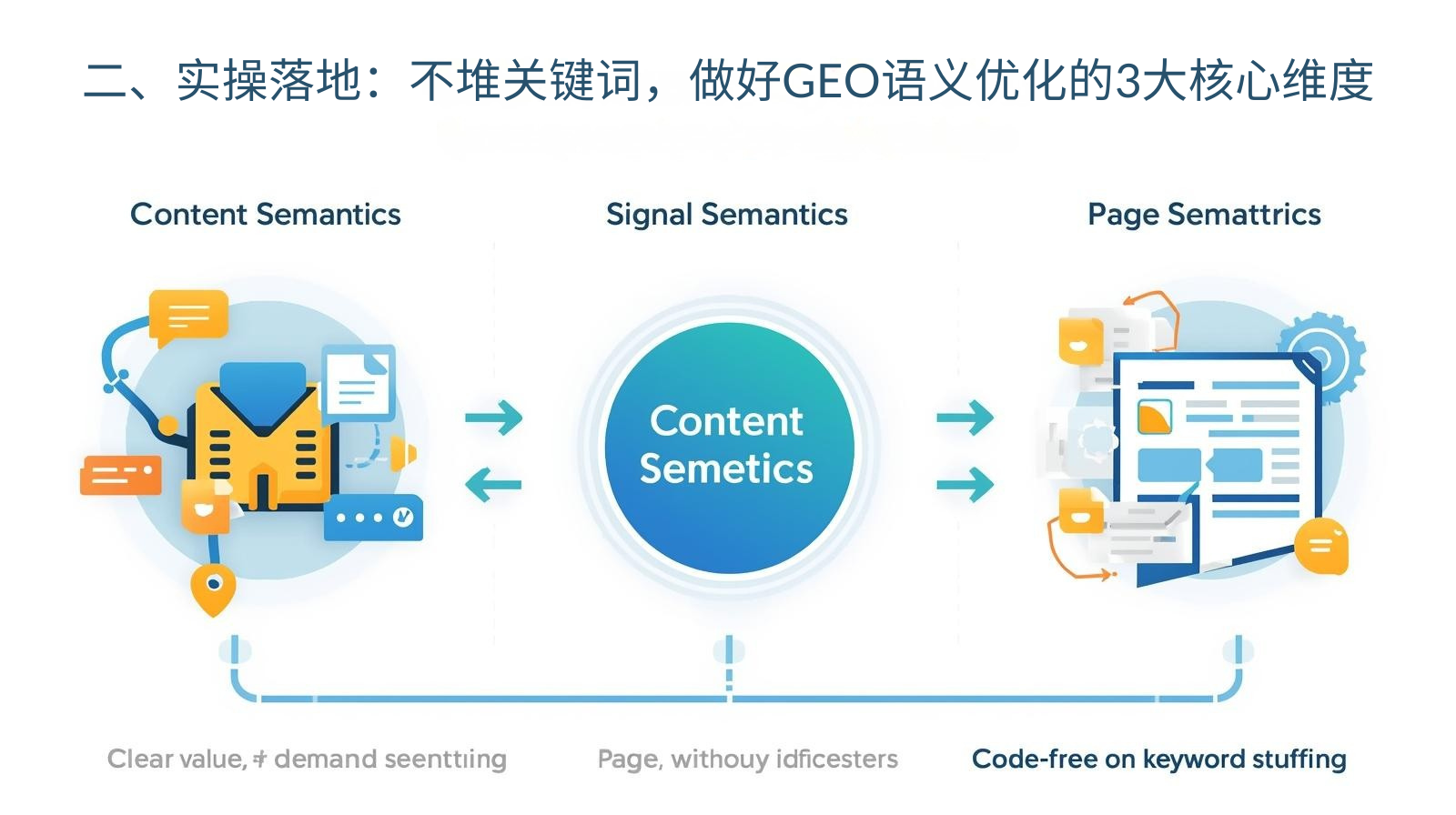
II. Practical Implementation: Avoid Keyword Stuffing and Focus on 3 Core Dimensions of GEO Semantic Optimization
GEO semantic optimization requires no complex technical operations. It revolves around three dimensions: "content semantics, signal semantics, and page semantics." The core principles are "semantic coherence, clear value, and demand matching." The entire process is code-free, tailored to foreign trade scenarios, and supported by authoritative backlinks. It can be directly replicated and implemented regardless of the size of the site, achieving the goal of "allowing AI to understand core value without keyword stuffing." Every practical operation is aligned with the characteristics of AI semantic understanding in 2026.
2.1 Dimension 1: Content Semantic Optimization (Core Focus, the Core Carrier of AI Recognition)
Content is the core carrier of AI semantic recognition and the most important aspect of semantic optimization. The core is to "create content that is logically coherent, has clear value, and addresses the pain points of buyers," naturally integrating keywords into the semantic logic rather than piling them up. This allows AI to quickly understand the core value and professionalism through the content context, while also aligning with the reading habits of foreign trade buyers.
2.1.1 Core Practical Skills (Directly applicable, no keyword stuffing)
1. First define the core value, then organize the semantic logic: For each piece of content (product page, special page, news page), first clarify the core semantic meaning of the core value (e.g., "Low-cost solution for EU CE certification for SMEs in foreign trade" or "Small-batch customization process and advantages for foreign trade toys"). Then, organize the content logic around the core semantic meaning, such as "identifying pain points → analyzing causes → providing solutions → supplementing and extending," ensuring that the content logic is coherent and progressive, allowing AI to quickly identify the core value through the logical framework. At the same time, combine the latest EU compliance rules for 2026 (refer to the official EU external link: https://ec.europa.eu/growth/single-market/european-standards/ce-marking_en) to enhance the professionalism of the content and strengthen its semantic value. 2. Integrate keywords naturally, aligning with semantic logic: Select 1-2 precise long-tail keywords that match the core semantics (e.g., if the core semantics are "low-cost CE certification solution," the long-tail keyword could be "low-cost CE certification application method in 2026"). Integrate these keywords naturally into the title, opening, core paragraphs, and conclusion of the content, ensuring logical consistency and avoiding forced repetition or isolated keyword stuffing. For example, the title could be "Low-cost CE certification solution for SMEs in foreign trade in 2026," and the opening could be "Many SMEs in foreign trade face the problem of excessively high CE certification costs when exporting to the EU. Today, we will share a low-cost, efficient CE certification application method," naturally incorporating the keywords while conveying the core value. 3. Strengthen contextual connections and avoid semantic breaks: Each paragraph of the content should revolve around the core semantics, and there should be logical connections between paragraphs to avoid problems such as "paragraph disconnect and semantic confusion". For example, if the previous paragraph discusses the core pain points of CE certification, the next paragraph should discuss the corresponding solutions. The context is closely connected, so that AI can understand the complete meaning of the content through paragraph connections. At the same time, avoid the inclusion of content that is not related to the core semantics. For example, when discussing CE certification, do not insert irrelevant logistics information to ensure semantic focus. 4. Adapt to Buyers' Semantic Habits and Improve Demand Matching: Based on the semantic search habits of foreign trade buyers, use language they commonly use to address their needs and scenarios. For example, buyers often ask questions using phrases like "how," "how to," "what to do," and "how much." Content can adopt question-and-answer semantics (e.g., "How can small and medium-sized foreign trade enterprises obtain CE certification at low cost?") or demand-based semantics (e.g., "Low-cost CE certification solutions suitable for small and medium-sized foreign trade enterprises") to improve the match with buyers' semantic needs. Refer to the Semrush 2026 Foreign Trade Buyer Semantic Habits Report (link: https://www.semrush.com/blog/2026-foreign-trade-semantic-habit/).
2.1.2 Practical Case Studies in Foreign Trade Scenarios (Can be directly referenced, without keyword stuffing)
Core semantics: Compliant small-batch export solution for toys for SMEs in the foreign trade industry (precise long-tail keywords: compliant small-batch export of toys, compliant small-batch MOQ solution for toys); Content excerpt: Many start-up SMEs in the foreign trade industry face two major challenges when exporting toys: firstly, the MOQ for small-batch purchases is difficult to meet the requirements of their competitors; secondly, they are unclear about the latest EU toy compliance standards (EN 71 Directive) for 2026, worrying about compliance risks and ultimately missing out on overseas orders. Addressing these two pain points, we combine our years of experience in exporting toys with the latest official EU compliance requirements (refer to the official EU external link: https://ec.europa.eu/growth/single-market/european-standards/ce-marking_en) to provide SMEs in the foreign trade industry with a compliant small-batch export solution. This solution meets the MOQ requirements for small-batch purchases (minimum MOQ of 50 pieces) while ensuring that products comply with the EU EN 71 compliance standard, helping SMEs in the foreign trade industry start their toy export business at low cost and low risk. Our core solution is "streamlining compliance processes and optimizing supply chain configuration." It allows companies to quickly complete compliance testing without significant cost investment. Simultaneously, a dedicated compliance consultant assists companies throughout the process, helping them clarify compliance details and resolve various compliance challenges encountered during export. This enables small and medium-sized foreign trade enterprises to easily connect with overseas buyers and capture market share in the overseas toy market. (Note: The case study naturally incorporates two precise long-tail keywords, with coherent semantic logic and a clear core value. Without keyword stuffing, AI can quickly understand the core value of "small and medium-sized foreign trade enterprises' small-batch compliant export solution for toys," while also addressing the pain points of buyers.)
2.2 Dimension Two: Signal Semantic Optimization (aligning with GEO to enable AI to understand value matching degree)
GEO signals are an important supplement to AI in identifying the value of a site. The core of signal optimization under semantic optimization is to "make the semantics of the signal highly matched with the semantics of the content and the core value of the site", avoiding the disconnect between the signal and the semantics and the stacking of signals. This allows AI to further clarify the core value and advantages of the site through the semantic association between the signal and the content, rather than simply stacking up signal keywords.
2.2.1 Core Practical Techniques (No Signal Stacking, Semantic Matching)
1. Consistency between Signal Semantics and Core Value: Select GEO signals that match the site's core value and content semantics, avoiding the addition of irrelevant signals. For example, if the site's core value is "small-batch customized compliant export," focus on optimizing signals related to "small-batch customization" and "low-cost compliance," avoiding irrelevant signals such as "large-batch procurement" and "high-end customization," ensuring consistency between signal semantics and core value. Simultaneously, the expression of signals should conform to semantic logic, avoiding isolated signal keywords. For example, describe the signal as "small-batch customization solutions for small and medium-sized foreign trade enterprises," rather than simply piling up "small batch" and "customization." 2. Semantic Linkage between Signals and Content: Each GEO signal must find semantic support within the content of its corresponding page, avoiding a disconnect between signal and content. For example, if the page signal is "low-cost solution for 2026 EU CE certification," the content should revolve around this semantic meaning, detailing the specific content of the solution. This allows AI to verify the authenticity of the signal and the site's professionalism through the semantic connection between the signal and the content. Additionally, the Rank Math tool (link: https://rankmath.com/) can be used to assist in checking the semantic matching degree between signals and content, ensuring smooth linkage. 3. Concise and precise signals, avoiding redundancy and unnecessary padding: For core pages (product pages, homepage, special pages), each type of GEO signal (demand signal, compliance signal, value signal, trust signal) retains only 1-2 core signals to ensure conciseness and semantic precision. For example, the value signal on the product page should only retain "small batch customization, low-cost compliance," avoiding multiple signals such as "customization," "compliance," "export," "MOQ," and "logistics" to prevent semantic confusion and allow AI to quickly identify the value corresponding to the core signal. 4. Signal expressions aligned with AI semantic habits: Signal expressions should be concise, clear, and semantically precise, aligning with the characteristics of AI semantic understanding in 2026. Avoid vague or ambiguous expressions. For example, optimize "low MOQ" to "small-batch MOQ of 50 pieces or more for small and medium-sized foreign trade enterprises," and optimize "compliance" to "complies with the 2026 EU EN 71 compliance standard," allowing AI to quickly understand the specific meaning and value of the signal.
2.3 Dimension Three: Page Semantic Optimization (Building a Solid Foundation to Enable AI to Understand the Overall Value of the Site)
Page semantic optimization is the foundation of semantic optimization. Its core is to "make the overall page structure, navigation logic, and page relationships of the site form a coherent semantic system". This allows AI to understand the overall core value and positioning of the site through the semantic relationships between pages, rather than looking at individual pages in isolation. At the same time, it improves the user experience for buyers and indirectly increases the AI's recognition of the site.
2.3.1 Core Practical Skills (Clear Structure, Coherent Meaning)
1. **Semantic Coherence in Page Structure:** Optimize the overall site structure, building page structures according to the semantic logic of "Core Value → Product Categories → Solutions → Content Support → Inquiry Entry." For example, the homepage clearly states the site's core value (a supplier for small and medium-sized foreign trade enterprises seeking compliant small-batch exports). Navigation is then divided into sections such as Product Categories, Compliance Solutions, Procurement Guide, and About Us. Each section's semantics revolve around the core value, allowing AI to quickly understand the site's overall positioning and value system through the page structure. Simultaneously, optimize page layout to avoid redundant information and ensure semantic focus. 2. **Semantic Consistency in Page Association:** Strengthen the connections between pages within the site. Link semantically related pages through internal links. For example, the "CE Certification Solutions" page links to semantically related pages such as "EU Compliance Procurement Guide" and "CE Certification Cases." This allows AI to understand the semantic connections between pages through internal links, forming a complete semantic system. Furthermore, the anchor text for internal links uses clear semantic expressions, avoiding isolated keywords. For instance, the anchor text uses "CE Certification Cases for Small and Medium-sized Foreign Trade Enterprises" instead of simply "CE Certification." 3. Clear and easy-to-understand navigation semantics: Optimize site navigation. The semantics of navigation names should be clear and relevant to the core value, avoiding vague or ambiguous expressions. For example, optimize the navigation name "Products" to "Foreign Trade Toys (Small Batch Customization)" and "Services" to "Compliant Export Solutions". This will allow both AI and buyers to quickly understand the core semantics of each navigation section, while ensuring that the navigation logic is coherent and fits the browsing habits of buyers. 4. Inquiry Entry Semantic Alignment: Add inquiry entry points to core pages (product pages, solution pages, content pages). The wording of the inquiry entry should align with the page's semantics and core value, such as "Get your customized small-batch compliant export solution" or "Consult details on low-cost CE certification processing," rather than simply using "Inquiry" or "Contact Us." This allows AI to further confirm the site's core value through the semantics of the inquiry entry, while guiding buyers to proactively make inquiries. Simultaneously, optimize the inquiry process, simplify the inquiry steps, and improve user experience, referring to Google's official 2026 Foreign Trade Site User Experience Guidelines (link: https://support.google.com/webmasters/answer/7451184?hl=en).
III. Avoiding Pitfalls: 4 Common Mistakes in GEO Semantic Optimization (A Must-Read to Avoid Keyword Stuffing)
Many foreign trade websites still fall into common pitfalls when implementing GEO semantic optimization. While seemingly avoiding keyword stuffing, they still fail to enable AI to understand their core value, leading to ineffective optimization and wasted resources. Based on practical lessons learned from GEO semantic optimization for independent foreign trade websites in 2026, the following four common misconceptions are highlighted, each accompanied by specific corrective measures to ensure quick avoidance of pitfalls and precise, effective semantic optimization.
3.1 Misconception 1: Vague semantics and unclear core value
Errors manifest as follows: The semantic logic of content, signals, and pages is chaotic, and the core value is vague. For example, the site talks about "small batch customization," "large batch export," and "high-end customization," which is not semantically focused. The content lacks a clear core semantic meaning, and it is rambling, talking about compliance, logistics, and after-sales service, making it impossible for AI to identify the core value of the site through semantic logic. At the same time, keywords are naturally integrated too much, resulting in semantic incoherence.
Key harms : AI cannot understand the core value and positioning of a website, cannot accurately match the semantic needs of buyers, and has extremely low crawling and referral rates; buyers cannot quickly grasp the core advantages of the website, resulting in a high bounce rate and difficulty in achieving conversion; in the long run, the website cannot accumulate core value and is difficult to gain recognition from the AI ecosystem.
Correct approach : Clearly define the core positioning and core value of the site, focusing on 1-2 core semantics (such as "small and medium-sized foreign trade enterprises exporting in small batches in compliance with regulations"), avoiding overly broad or vague semantics; every piece of content, every signal, and every page should revolve around the core semantics, ensuring semantic logic is coherent and focused; keywords should be naturally integrated in moderation, prioritizing semantic coherence and value clarity, rather than deliberately incorporating keywords.
3.2 Misconception 2: Disconnect between signal and semantics, signal stacking and concealment
Error manifestation : Although there is no keyword stuffing, it falls into the trap of "invisible signal stuffing", adding a large number of GEO signals that are unrelated to the semantics and core value of the content. For example, the semantics of the content is "CE certification solution", but irrelevant signals such as "logistics timeliness", "payment method" and "product price" are added. At the same time, the signals are disconnected from the semantics of the content. The signal is expressed as "low-cost compliance", but there is no relevant introduction to low-cost compliance in the content, making it impossible for AI to connect the semantics of the signal and the content.
Key harms : AI cannot identify the core value of a site through the semantic association between signals and content, rendering the signals meaningless; irrelevant signals will dilute the site's weight and affect the AI's recognition of the core semantics; at the same time, the disconnect between signals and semantics will cause AI to judge the site's "value as unclear", reducing the site's weight and crawling rate.
Correct approach : Signal selection should align with content semantics and the site's core value, avoiding the addition of irrelevant signals. Each signal must have semantic support within the content of its corresponding page. Core pages should retain only 1-2 core signals to ensure conciseness and semantic accuracy. Simultaneously, the expression of signals should be highly consistent with the content semantics, enabling AI to quickly identify the site's core value through the semantic association between signals and content.
3.3 Misconception 3: Ignoring contextual relationships and semantic breaks
Errors include : a lack of semantic connection and breaks between content paragraphs and pages; for example, a paragraph might discuss "pain points of CE certification" and then suddenly jump to "product introduction" without any logical connection; there is no semantic relationship between pages, the core semantic of the homepage is "small batch customization," but the semantic of the product page is "large batch export," making it difficult for AI to understand the overall semantic system of the site; at the same time, there are many isolated sentences in the content, lacking contextual connections, making it impossible for AI to recognize the semantic meaning of the sentences.
Key harms : AI cannot understand the complete meaning of content and the overall core value of the site through contextual association; semantic breaks reduce the readability and professionalism of content, leading to a high bounce rate among buyers; at the same time, semantic disconnect between pages prevents AI from forming a stable understanding of the site, affecting the overall site ranking.
Correct approach : When creating content, focus on the logical connection between paragraphs, with each paragraph revolving around the core semantics. Use transitional sentences to connect paragraphs and ensure semantic coherence. Optimize the site's page structure, strengthen the semantic connections between pages, and link semantically related pages through internal links to form a complete semantic system. Avoid isolated sentences and ensure that every sentence is integrated into the context, allowing AI to understand the semantic meaning through the context.
3.4 Misconception 4: Not aligning with the semantic habits of buyers, resulting in semantic misalignment.
Error Manifestation : Semantic optimization focuses solely on "making AI understand," neglecting the semantic search habits of buyers. The semantic expressions of content, signals, and pages are misaligned with the common semantics used by buyers. For example, buyers often use semantic searches such as "small batch MOQ" or "how to export in compliance with low cost," but the semantic expressions of the site content are "small batch purchase quantity" or "compliant export low-cost solution." Although the semantics are similar, they cannot accurately match the buyer's search intent. At the same time, using overly professional and obscure semantic expressions makes it impossible for buyers to understand and also cannot be recognized by AI as semantics that meet their needs.
Key harms : It cannot accurately match the semantic search intent of buyers. Even if AI can understand the core value, it is difficult to obtain accurate exposure; buyers cannot understand the semantics of the content, resulting in a high bounce rate and difficulty in achieving conversion; semantic misalignment will lead to optimization actions being out of touch with needs, wasting optimization costs.
Correct approach : Use tools such as Semrush and Google Search Console (link: https://www.semrush.com/) to filter commonly used semantic search terms by buyers, align with their semantic habits, and optimize the semantic expression of content, signals, and pages. Semantic expression should be professional and easy to understand, avoiding overly obscure terms, while also fitting the foreign trade procurement scenario, so that both AI and buyers can quickly understand the semantic meaning, achieving "AI understands, and buyers approve".
Recommended Article: Your Competitors Haven't Reacted Yet: Building an Independent E-commerce Website with GEO is the Biggest Blue Ocean Strategy Right Now
Recommended Article: Your Competitors Haven't Reacted Yet: Building an Independent E-commerce Website with GEO is the Biggest Blue Ocean Strategy Right Now
IV. Conclusion: Semantic optimization allows AI to become a bridge for conveying your core value.
In 2026, the continuous upgrading of AI semantic understanding capabilities is fundamentally changing the GEO optimization logic of independent foreign trade websites—the era of keyword stuffing is long gone; semantic optimization is the core path to achieving AI-prioritized crawling and precise exposure. The core of GEO semantic optimization has never been "stuffing keywords in a different way," but rather "delivering core value." It's about enabling AI to understand your site's positioning, product advantages, and solutions, and allowing buyers to quickly obtain the value they need, achieving the dual goals of "AI recognition and buyer selection."
For independent e-commerce websites, effective GEO semantic optimization doesn't require complex technical operations or significant investment. It simply requires abandoning the pitfalls of keyword stuffing and focusing on three core dimensions: content semantics, signal semantics, and page semantics. Adhering to the principles of semantic coherence, clear value, and demand matching, continuous optimization and refinement will allow AI to understand your core value without keyword stuffing. This will enable your site to become a high-value e-commerce site prioritized by the AI ecosystem, achieving long-term, stable exposure and precise inquiries.
The foundation of all this lies in having a robust website infrastructure adapted for semantic optimization and AI crawling. Many foreign trade websites, despite implementing semantic optimization, still struggle to gain AI recognition. The core issue is outdated underlying technology, disorganized page structures, and slow loading, failing to support a coherent presentation of the semantic system. This prevents AI from smoothly crawling and understanding the semantics, ultimately impacting optimization effectiveness. PinDian Technology, with over ten years of experience in foreign trade website building and serving more than 7,000 clients, utilizes React technology. This not only ensures a smoother website browsing experience (overseas loading speed ≤2 seconds, perfectly adaptable to multi-device access) but also fundamentally adapts to GEO semantic optimization and AI crawling requirements—building a clear page structure, optimizing page relationship logic, adapting to AI semantic recognition rules, and supporting the construction of modules such as compliant content display and precise signal configuration, providing solid technical support for the implementation of semantic optimization.
PinDian website building can simultaneously assist businesses in clarifying the core semantics of their sites, optimizing content semantic logic, and configuring precise GEO signals. Combined with the practical methods described in this article, it allows your site to be quickly understood by AI for its core value without keyword stuffing, improving AI crawling rates and accurate exposure. If your site is facing the dilemma of "ineffective keyword stuffing, AI's inability to understand core value, and low exposure accuracy," consider PinDian Technology. With professional website building and optimization services, we can optimize GEO semantics, making AI a bridge to convey your core value and helping your independent foreign trade website stand out and achieve performance breakthroughs in the AI era of 2026.