
A report titled "Long-Term Value Report on GEO Optimization for Foreign Trade," released by OpenAI and Ahrefs in February 2026, revealed that 90% of the failures of GEO (Generative Engine Optimization) for independent foreign trade websites stemmed from a "short-term speculative mindset"—an excessive pursuit of rapid exposure, blindly piling up signals and keywords, and neglecting content authority and user experience. This ultimately led to the sites being judged as "low-value sites" by the AI ecosystem, resulting in decreased crawling frequency and a sharp drop in exposure. Even with subsequent investment, it was difficult to regain AI trust. Conversely, foreign trade sites that adhered to a long-term GEO approach saw an average increase of 72% in AI citation rate, site weight, and precise inquiries during the 2026 AI ecosystem iteration, becoming the preferred authoritative source of foreign trade information recommended by the AI ecosystem. In fact, the core of GEO optimization is not "short-term traffic surges," but "long-term value accumulation." Only by focusing on long-term principles, continuously creating authoritative content, optimizing site experience, and aligning with AI ecosystem iterations can a site become an authoritative foreign trade site recognized by the AI ecosystem, achieving long-term stable growth in traffic and performance.
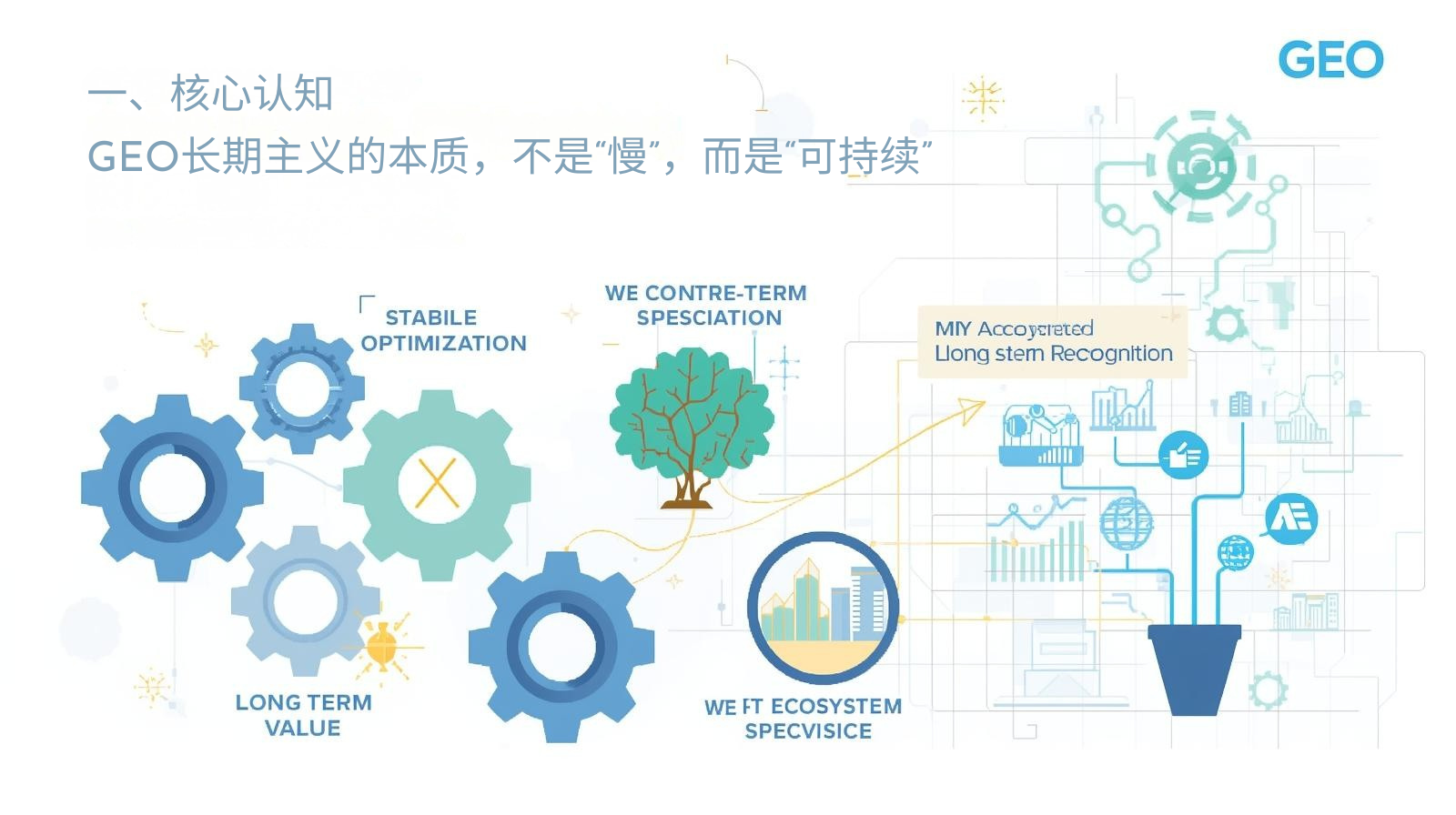
I. Core Insight: The essence of GEO long-termism is not "slow," but "sustainability."
Many foreign trade websites have misconceptions about GEO long-termism, believing that "long-termism means taking things slowly and not pursuing results," which is not the case. The core of GEO long-termism is "rejecting short-term speculation and focusing on long-term value." With the goals of "AI ecosystem recognition, buyer trust, and website authority," it accumulates website value and brand influence through continuous, stable, and precise optimization, ultimately achieving a sustainable state where "AI continuously crawls and prioritizes websites, leading to proactive buyer selection." Compared to short-term speculation, it emphasizes "quality over quantity, precision over breadth, and long-term over immediate," which aligns perfectly with the core iteration direction of the AI ecosystem in 2026—AI increasingly values the long-term value and authority of websites, rather than short-term optimization actions. Referencing OpenAI's "AI Ecosystem Website Evaluation Guidelines" released in February 2026 (link: https://platform.openai.com/docs/guides/generative-search/ai-ecosystem-evaluation), it explicitly includes "long-term website optimization stability" and "content authority accumulation" as core evaluation indicators, accounting for 40% of the weight.
1.1 The core difference between GEO long-termism and short-term speculation (specific to foreign trade scenarios)
Clearly understanding the core differences between the two is crucial to completely abandoning short-term speculative thinking, establishing a correct long-term perspective, and avoiding detours and wasted costs. The differences are relevant to the actual optimization practices of foreign trade GEOs and are easy to understand: ① Different optimization goals: Short-term speculation aims to "rapidly increase AI exposure and crawling frequency," neglecting conversion and authority, and even using illegal optimization methods (such as keyword stuffing and fake backlinks); long-termism aims to "build an authoritative site recognized by the AI ecosystem," balancing AI crawling, buyer trust, and long-term conversion, pursuing sustainable growth; ② Different content strategies: Short-term speculation pursues content quantity, mass-producing low-quality, non-original content lacking professionalism and value; long-termism focuses on content authority, continuously creating high-quality, original content that addresses buyer pain points, accumulating industry professional value, such as continuously outputting the latest interpretation of EU compliance in 2026 and practical guides for foreign trade procurement; ③ The optimization actions differ: Short-term speculation involves blindly piling up GEO signals and adding irrelevant backlinks in bulk, resulting in chaotic and unplanned optimization. Long-term optimization focuses on continuity and precision, regularly optimizing GEO signals, updating content, and maintaining backlinks, aligning with the AI ecosystem's iterative pace. Refer to the Semrush 2026 Foreign Trade GEO Optimization Trend Report (link: https://www.semrush.com/blog/2026-foreign-trade-geo-trend/). The final results also differ: Short-term speculation may yield temporary exposure gains, but it's easily flagged by AI as a violation, leading to a drop in site authority and zero exposure, making it unsustainable. Long-term optimization, while slower to show results, gradually gains recognition from the AI ecosystem, achieving continuous and stable improvements in AI crawling, exposure, and conversion, establishing brand authority, and forming core competitiveness.
1.2 Authoritative foreign trade websites recognized by the AI ecosystem must meet four core standards.
In 2026, the AI ecosystem's evaluation of authoritative foreign trade websites will no longer be limited to "original content and complete signal," but will place greater emphasis on four core standards: "long-term value, professional authority, user experience, and ecosystem adaptation." This is also the core focus of GEO's long-term approach. Each standard has clear evaluation dimensions and practical requirements, tailored to foreign trade scenarios: ① Content Authority: The content possesses industry professionalism and uniqueness, including the latest industry data, compliance requirements, and practical solutions for 2026, supported by authoritative external links (such as EU official sources, SGS, and Global Sources), and can continuously provide valuable information to buyers, rather than being superficial; ② Optimization Stability: GEO's optimization actions are continuous and regular, with regular content updates, site optimization, and external link maintenance, without long-term stagnation or illegal optimization behavior, and the site's authority steadily increases; ③ Excellent User Experience: The site loads smoothly (overseas loading speed ≤2 seconds), has a clear structure, good multi-terminal adaptation, a convenient inquiry process, allows buyers to quickly obtain the information they need, and has a low bounce rate (≤30%); ④ Ecosystem Adaptability: It can continuously keep pace with the iteration rhythm of the AI ecosystem, adjust and optimize strategies in a timely manner, and adapt to the updates of AI crawling rules. For example, after the AI semantic understanding upgrade in 2026, it can adjust the content creation logic to fit the AI crawling preferences. Refer to Google's official 2026 Foreign Trade Website Adaptation Guide (link: https://support.google.com/webmasters/answer/7451184?hl=en).
1.3 The AI ecosystem iteration in 2026: New requirements for GEO long-termism
The AI ecosystem is constantly iterating, and the core iterative directions for 2026 are "authoritativeness, precision, and scenario-based application." This also presents three new requirements for GEO long-termism, which foreign trade websites need to focus on and adapt to in a timely manner to continue gaining AI recognition: ① Upgraded requirements for authority: AI no longer recognizes "purely original" content, but prioritizes content "supported by authority and with professional accumulation," such as content including industry expert interpretations, third-party testing reports, and official data. Refer to the Global Sources 2026 Foreign Trade Authoritative Site Report (link: https://www.globalources.com/industry-report/2026-authority-site); ② Upgraded requirements for precision: AI has higher requirements for the precision of GEO signals, no longer accepting "signal stacking," but requiring signals to be highly matched with content, products, and buyer needs. For example, compliant products should focus on optimizing compliance signals, and customized products should focus on optimizing demand signals; ③ Upgraded scenario requirements: AI will be combined with foreign trade procurement scenarios (such as small-batch procurement, compliant procurement, and cross-border logistics) to assess the scenario adaptability of the site. Long-term vision requires focusing on its own core scenarios, continuously optimizing scenario-based content and experience, and creating an authoritative scenario-based site.
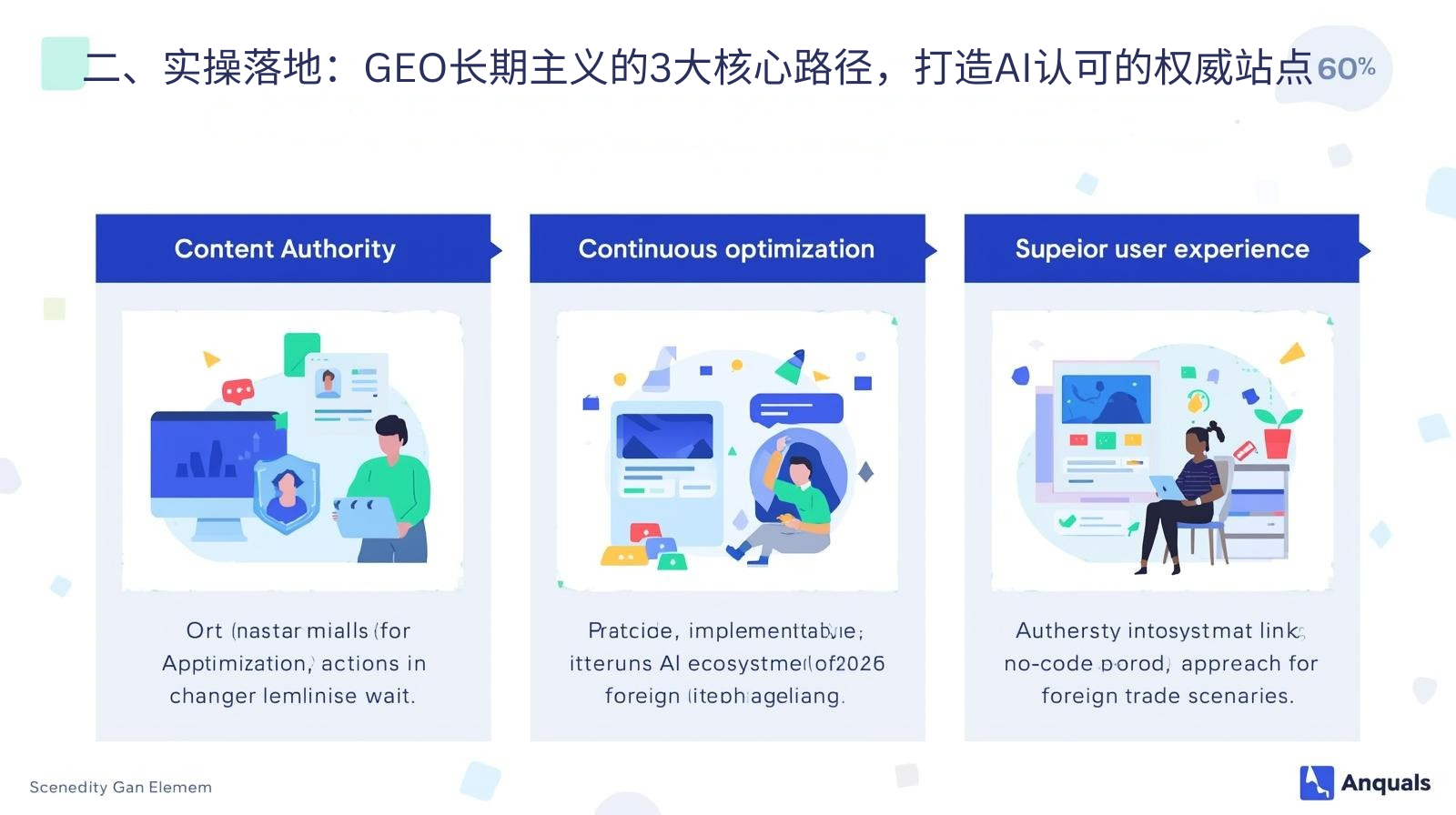
II. Practical Implementation: The 3 Core Paths of GEO Long-Termism to Build an Authoritative Website Recognized by AI
GEO's long-term approach is not about "passively waiting" but about "actively accumulating value." Its core is to carry out continuous, precise, and implementable optimization actions around three paths: "content authority, continuous optimization, and high-quality experience." This aligns with the AI ecosystem iteration requirements of 2026, integrates authoritative external links, is entirely no-code, and is tailored to foreign trade scenarios. Regardless of the size of the site, it can be directly replicated and implemented, gradually gaining recognition from the AI ecosystem and accumulating long-term value.
2.1 Path 1: Long-term in-depth cultivation of content to accumulate authoritative value (core path)
Content is the core of GEO optimization and the core basis for AI to assess the authority of a site. The core of content optimization under the long-term perspective is "from quantity to quality, from generalization to precision, and from single to systematic". It is about continuously accumulating authoritative value in the industry, so that both AI and buyers recognize the site's professionalism, rather than blindly pursuing the quantity of content. Every action should focus on long-term accumulation.
2.1.1 Content System Development (Long-term planning, feasible)
Based on our own product scenarios (such as compliance, customization, and home furnishing), we will build a comprehensive content system covering the pain points of buyers throughout the entire process, ensuring the continuity and systematic nature of the content and avoiding disorganization: ① Core Content System (Focus on Key Areas): We will build thematic content around the five core foreign trade scenarios of "compliance, procurement, customization, logistics, and after-sales service," such as "2026 EU Compliance Theme" and "Small Batch Procurement Theme." Each theme will contain 10-15 high-quality Q&A and interpretive articles to gradually build the authority of the themes. The compliance theme can add an official EU external link (link: https://ec.europa.eu/growth/single-market/european-standards/ce-marking_en) to enhance its authority; ② Regular Content System (Continuous Updates): We will update 1-2 high-quality articles every week, focusing on the high-frequency pain points of buyers and the latest industry trends. For example, after the 2026 EU compliance rules are updated, we will promptly output interpretive content, and before the peak procurement season, we will output procurement pitfall avoidance guides to ensure the timeliness of the content; ③ Authoritative Content Supplement (Enhancing Weight): One authoritative, in-depth article will be published monthly, combining industry data, expert interpretation, and client case studies. Examples include "2026 Foreign Trade Toy Industry Development Report" and "Practical Cases of Compliance Transformation for Small and Medium-sized Foreign Trade Enterprises." SGS testing data (link: https://www.sgsgroup.com/) and Global Sources industry data can be cited to enhance content authority and increase the probability of AI citation.
2.1.2 Creating Authoritative Content (Core Techniques, Aligning with AI Preferences)
1. Enhanced Professionalism: Content creation must incorporate the latest industry rules, compliance requirements, and procurement trends up to 2026, avoiding outdated information. For example, when mentioning CE certification, interpretations must follow the latest EU directives of 2026, avoiding the use of old standards. Furthermore, integrate your own professional experience to provide actionable solutions, rather than simply copying official content, showcasing the site's professional advantages. 2. Strengthened Authority Support: Each core piece of content should include at least one authoritative external link, prioritizing links from official industry websites, authoritative testing institutions, and well-known industry platforms. For example, logistics content should include a link to DHL's official foreign trade logistics guide, and data content should include a link to a Global Sources industry report. Ensure the links are accessible and highly relevant to the content. Additionally, incorporate client success stories and screenshots of third-party testing reports to enhance credibility. 3. Originality and Uniqueness: Content originality ≥ 95%, achieved using Copyscape (link: https://www.copyscape.com/). 4. Content Update and Maintenance: Establish a long-term content maintenance mechanism, updating core content quarterly, supplementing with the latest industry data and compliance requirements, and deleting outdated information; at the same time, optimize content details based on AI reference data and buyer feedback to improve the accuracy and value of the content and ensure its long-term reference value.
2.2 Path Two: Continuous Optimization of GEO Signals to Align with AI Ecosystem Iteration
GEO signals are key to AI's ability to identify site value and match buyer needs. The core of signal optimization under a long-term perspective is "continuous, accurate, and adaptable," avoiding short-term accumulation. By combining with the AI ecosystem's iteration rhythm, the accuracy and completeness of signals are regularly optimized, allowing AI to continuously recognize the site's value while aligning with the needs of foreign trade products and buyers.
2.2.1 Long-term rhythm of signal optimization (can be directly applied)
Establish a standardized signal optimization rhythm to ensure continuous and regular optimization actions that align with AI ecosystem iterations and avoid blind adjustments: ① Weekly: Check the completeness of GEO signals, focusing on identifying missing signals on core pages (product pages, compliance topic pages), and promptly supplement missing signals (such as trust signals and demand signals). Use the Rank Math tool (link: https://rankmath.com/) to assist in the check and ensure no signals are missed; ② Monthly: Optimize the accuracy of signals, combining the high-frequency long-tail keywords for buyers in 2026 selected by the Semrush tool (link: https://www.semrush.com/), adjust the matching degree between signals and keywords, and delete signals irrelevant to content and products to avoid signal stacking; ③ Quarterly: In conjunction with AI ecosystem iteration trends (pay attention to OpenAI official announcements, link: https://platform.openai.com/docs/updates), adjust the focus of signal optimization. For example, after the upgrade of AI semantic understanding, optimize the expression of signals to align with AI crawling logic; at the same time, optimize the internal link structure of the site to guide AI to crawl more core content and improve the overall site weight; ④ Every year: We comprehensively review the GEO signaling system, combine industry trends and product upgrades, optimize the signaling layout, and ensure that the signaling is highly matched with the site positioning, product advantages, and purchaser needs to form a complete signaling system that enables AI to quickly identify the core value of the site.
2.2.2 Key Points of Signal Optimization (Avoiding Pitfalls)
1. Precise Matching: Signals should be highly aligned with content, products, and buyer needs. For example, for export toys, focus on optimizing signals related to "EU EN 71 compliance" and "small batch customization MOQ," avoiding signals unrelated to toys (such as furniture compliance). Signals should be naturally worded, logically consistent, and not artificially constructed to avoid being flagged as over-optimized by AI. 2. Emphasizing Key Focus: Focus on core signals and leverage product advantages to optimize 1-2 key signals. For example, small and medium-sized export enterprises should focus on optimizing signals like "small batch procurement" and "low-cost compliance" to create a differentiated advantage, allowing AI to quickly identify the site's core value. 3. Adapting to Iterative Development: Adapt to timely AI ecosystem iterations. For example, in 2026, AI will place greater emphasis on scenario-based signals. Incorporate scenario keywords (such as "small batch customization for startup buyers") into signals to improve their relevance. Avoid using illegal signal optimization methods (such as fake certification signals or fake customer cases), otherwise, AI will classify the site as low-value, impacting long-term development. 4. Linked Content: Signals and content are deeply linked. For example, if the content mentions "EU CE certification process in 2026", compliance signals and trust signals (such as CE certification marks and official external links) are simultaneously embedded, allowing AI to quickly associate signals with content and improve the site's authority assessment.
2.3 Path Three: Long-term upgrade of user experience to enhance AI and buyer recognition
User experience is an important supplement to AI's assessment of a site's authority and a key to improving buyer conversion. The core of user experience optimization under a long-term perspective is "continuous upgrading and meeting needs." From multiple dimensions such as site loading, structure, and inquiry experience, we create a high-quality user experience, so that AI recognizes the site's usability, and buyers are willing to stay and actively inquire, while laying the foundation for long-term conversion.
2.3.1 Core Experience Optimization Directions (Ongoing Implementation)
1. Site Loading Optimization: Continuously optimize site loading speed through Cloudflare CDN acceleration (link: https://www.cloudflare.com/) and TinyPNG image compression (link: https://tinypng.com/) to ensure overseas loading speeds are ≤2 seconds, preventing AI crawling anomalies and buyer crashes due to slow loading; simultaneously, regularly check site servers to ensure stable site operation, no faults, no lag, and an AI crawling error rate ≤3%; 2. Site Structure Optimization: Continuously optimize the site structure to ensure a clear hierarchy of "core layer - auxiliary layer - brand layer," with core content (product pages, compliance topic pages) prominently displayed for easy AI crawling and buyer search; simplify site navigation and optimize page layout to avoid redundant information, allowing buyers to quickly obtain the information they need; 3. Multi-Terminal Adaptation Optimization: Continuously optimize the site's multi-terminal adaptability to ensure smooth browsing on computers, mobile phones, tablets, and other terminals, with normal content and signal display, aligning with the 2026 AI multi-terminal crawling trend, while improving the buyer's browsing experience; 4. Inquiry experience optimization: We continuously optimize the inquiry process, simplify inquiry steps, and add clear inquiry entry points (online consultation, email, contact information) on core pages (product pages, content pages) to facilitate quick inquiries from buyers; at the same time, we respond to inquiries promptly, establish an inquiry follow-up mechanism, improve buyer satisfaction, generate positive user reputation, and indirectly enhance AI's recognition of the site.
2.3.2 Long-term monitoring of experience optimization (to ensure effectiveness)
Establish a long-term user experience monitoring mechanism. Utilize Google Analytics (link: https://analytics.google.com/) to regularly monitor site bounce rate, average dwell time, inquiry conversion rate, and other data. Extract core data weekly and analyze the underlying issues (such as the reasons for high bounce rate and low inquiry conversion rate). Simultaneously, collect feedback from buyers and specifically optimize user experience shortcomings. For example, if buyers report that the inquiry entry point is not prominent, adjust its location and style promptly. Ensure continuous improvement of the user experience, aligning with the needs of AI and buyers, and providing support for the site's long-term authoritative development.
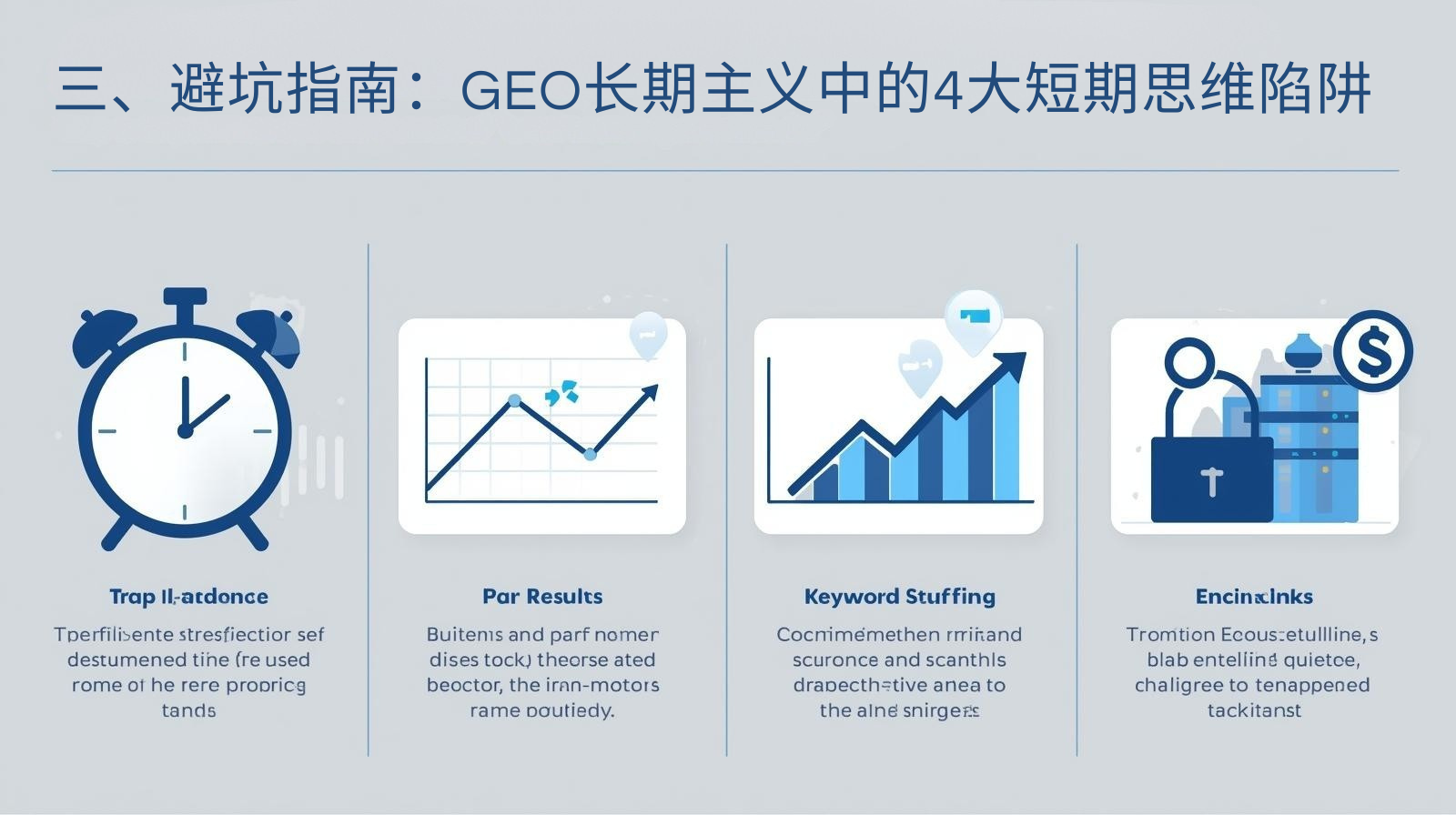
III. Pitfall Avoidance Guide: 4 Short-Term Mindset Traps in GEO Long-Termism (Essential for Foreign Trade Websites)
Many foreign trade websites, while recognizing the long-term nature of GEO (Generative Ecosystem Optimization), still unconsciously fall into the trap of short-sighted thinking during implementation. This leads to optimization actions deviating from the long-term direction, wasting costs, and even affecting the website's AI recognition. Based on practical lessons learned from GEO optimization of independent foreign trade websites in 2026, the following four pitfalls are the most common, each accompanied by specific corrective measures to ensure quick avoidance of these issues and adherence to long-term value accumulation.
3.1 Trap 1: Impatience and the pursuit of "quick results"
Common mistakes : After 1-2 months of optimization, if there is no significant improvement in AI exposure and crawling frequency, abandon long-term optimization and resort to short-term speculative methods (such as keyword stuffing and adding fake backlinks in bulk) in an attempt to quickly gain exposure; or even frequently adjust optimization strategies, resulting in disorganized and unsustainable optimization actions that fail to accumulate long-term value.
Key risks : Short-term speculative tactics are easily identified as violations by AI, leading to a drop in site ranking and zero exposure, which is difficult to recover; frequent strategy adjustments prevent AI from forming a stable understanding of the site, affecting crawling and referencing; ultimately, a lot of optimization costs are wasted, and long-term stable growth cannot be achieved.
Correct approach : Establish the understanding of "long-term effectiveness", clarify the effectiveness cycle of GEO long-termism (3-6 months), adhere to continuous and regular optimization actions, and do not rush for quick results; at the same time, formulate medium and long-term optimization plans, clarify the core goals and optimization priorities of each stage, and avoid frequent strategy adjustments; review data every month to check the subtle improvements in optimization effects, strengthen confidence in long-term optimization, and gradually build the site's authority.
3.2 Trap Two: Emphasizing quantity over quality and neglecting the authoritative accumulation of content.
Errors : In pursuit of "continuous updates," low-quality, non-original, and worthless content is created in batches. The content lacks professionalism and authoritative support, and may even plagiarize content from competitors. At the same time, the content is neglected to be updated and maintained, and is not optimized after creation, resulting in outdated and worthless content that fails to gain the approval of AI and buyers.
Key harms : Low-quality content will be judged as "low-value content" by AI, resulting in extremely low crawling and citation rates, and may even affect the overall site ranking; outdated content will convey incorrect information, damage brand reputation, and lead to the loss of buyers; in the long run, the site will be unable to accumulate authoritative value and will find it difficult to become an authoritative site recognized by the AI ecosystem.
The correct approach : Abandon the "quantity first" mentality and adhere to the "quality first" principle. Update 1-2 high-quality, original, and authoritative articles every week, focusing on creating thematic and in-depth content. At the same time, establish a long-term content maintenance mechanism, updating content and supplementing it with the latest information every quarter to ensure the timeliness and value of the content. Emphasize the professionalism and uniqueness of the content, accumulate authoritative value in the industry, and let AI and buyers recognize the site's professionalism.
3.3 Trap Three: Ignoring the iteration of the AI ecosystem and clinging to old optimization models
Errors include : sticking to an optimization strategy once it is determined, failing to pay attention to the iterative trends of the AI ecosystem, and not adjusting optimization actions. For example, after the upgrade of AI semantic understanding, the old content creation logic and signal implantation methods are still used; after AI emphasizes authoritative support in 2026, authoritative backlinks are still not added and professional content is not accumulated, resulting in the site becoming disconnected from the AI ecosystem.
Key harms : The site becomes disconnected from the AI ecosystem, with AI crawling and citation rates gradually declining and exposure stagnating; optimization efforts fail to align with the requirements of the AI ecosystem, and even with continuous optimization, it is difficult to gain AI recognition; in the long run, the site will be eliminated by the AI ecosystem and lose opportunities for precise customer acquisition.
Correct approach : Establish an AI ecosystem iteration monitoring mechanism, regularly pay attention to official announcements from OpenAI, Google, etc. (link: https://platform.openai.com/docs/updates) to keep abreast of the iteration direction of AI crawling rules; adjust optimization strategies, content creation direction, and signal optimization focus every quarter based on ecosystem iteration trends to ensure that the site always adapts to the AI ecosystem; at the same time, learn from the optimization experience of excellent and authoritative sites in the same industry, combine it with the characteristics of your own site, and continuously optimize to avoid sticking to old patterns.
3.4 Trap Four: Ignoring User Experience and Focusing Only on AI Data Scraping
Errors include : overemphasizing AI-driven crawling and exposure while neglecting the buyer's user experience, such as slow site loading, disorganized structure, and complex inquiry processes without optimization; focusing only on AI crawling preferences without considering the buyer's reading experience and actual needs, resulting in high bounce rates and low inquiry conversion rates.
Core harms : Poor user experience leads to the loss of buyers. Even if the site is crawled by AI and gains exposure, it cannot achieve conversion, and optimization loses its practical value. At the same time, the AI ecosystem will incorporate user experience into the evaluation of site authority. Sites with poor user experience will be judged as "low-value sites" by AI, and their crawling and referral rates will gradually decline. In the long run, the site will be unable to build brand trust and will find it difficult to achieve long-term stable development.
The correct approach is to establish a dual goal of "AI recognition + buyer recognition," balancing AI crawling with user experience, and continuously optimizing core dimensions such as site loading, structure, and inquiry experience; content creation should not only align with AI crawling preferences but also with buyers' reading habits and actual needs, providing valuable solutions; regularly monitor user experience data, collect buyer feedback, and specifically optimize experience shortcomings to ensure that both AI and buyers recognize the value of the site.
Recommended Article: Your Competitors Haven't Reacted Yet: Building an Independent E-commerce Website with GEO is the Biggest Blue Ocean Strategy Right Now
Recommended Article: Your Competitors Haven't Reacted Yet: Building an Independent E-commerce Website with GEO is the Biggest Blue Ocean Strategy Right Now
IV. Conclusion: Building Core Competitiveness for Foreign Trade Websites in the AI Era through Long-Term Persistence
In 2026, the continuous iteration of the AI ecosystem is reshaping the GEO optimization logic of independent foreign trade websites. Short-term speculation can only bring temporary traffic; only long-termism can solidify the website's authoritative value, making it a core source of foreign trade information recognized by the AI ecosystem and achieving long-term stable growth in traffic and performance. GEO optimization for independent foreign trade websites is never a "quick fix," but a "protracted war." It doesn't require complex optimization techniques or large cost investments; what it does require is patience, persistence, and the right direction.
With a long-term perspective at its core, we continuously cultivate authoritative content, ensuring that every piece of content provides value to buyers and gains AI recognition. We continuously optimize GEO signals to align with AI ecosystem iterations, enabling AI to quickly identify the site's core value. We continuously upgrade the user experience, balancing the needs of AI and buyers, making the site the buyer's first choice. Over time, your site will eventually become an authoritative foreign trade site recognized by the AI ecosystem, making AI your long-term free promoter, allowing your brand influence to continuously accumulate, and enabling you to gain a firm foothold and stand out in the competitive foreign trade landscape of the AI era.
The foundation of all this lies in having a website base adapted to GEO long-term optimization and the AI ecosystem. Many foreign trade websites adhere to long-termism, yet still struggle to gain AI recognition. The core issue is outdated underlying technology, slow loading, and a chaotic structure, failing to support the accumulation of authoritative content and continuous signal optimization, thus preventing the maximization of long-term optimization effects. PinDian Technology, with over ten years of experience in foreign trade website building and having served over 7,000 clients, uses React technology for website construction. This not only makes website browsing smoother (overseas loading speed ≤2 seconds, perfectly adaptable to multi-terminal access) but also adapts to the needs of GEO long-term optimization and the AI ecosystem from the ground up—building a clear website structure, optimizing content display and layout, configuring adapted structured markup, and supporting the construction of modules such as compliance certification, authoritative backlink display, and inquiry experience optimization, providing solid technical support for the implementation of GEO long-termism.
PinDian website building can simultaneously assist enterprises in developing medium- to long-term GEO optimization plans, building an authoritative content system, and optimizing GEO signals and user experience. Combined with the practical path outlined in this article, your site can gradually gain recognition from the AI ecosystem and solidify its core competitiveness through long-term optimization. If your site is facing the dilemma of "rushing to achieve GEO results, failing to gain AI recognition, and seeing no long-term optimization effects," consider PinDian Technology. With professional website building and optimization services, we practice long-term GEO principles, build the core competitiveness of your foreign trade site in the AI era, and achieve long-term stable growth.