
A report titled "AI Search Content Citation Trends," released by OpenAI and Ahrefs in February 2026, revealed that when foreign trade buyers search for supplier information through AI platforms like ChatGPT, 78% of their questions are presented in a "question-and-answer" format. When generating answers, AI prioritizes question-and-answer content that is "precisely matched to the question, highly professional, and clearly structured." Specifically, question-and-answer content from foreign trade independent websites optimized with GEO (Generative Engine Optimization) has a 65% higher probability of being cited by AI than ordinary content, resulting in an average increase of 58% in site exposure and targeted inquiries. For foreign trade independent websites, one of the core goals of GEO optimization is to ensure their content is prioritized for AI citation, becoming a core source of information for buyers. Question-and-answer content is the key link between the site, AI, and buyers—it accurately matches AI's question-and-answer crawling preferences and directly addresses buyers' core questions, allowing AI to proactively cite your professional content when answering buyer inquiries, boosting site exposure, building brand authority, and ultimately achieving precise customer acquisition.
I. Core Understanding: Why is GEO question-and-answer content prioritized by AI?
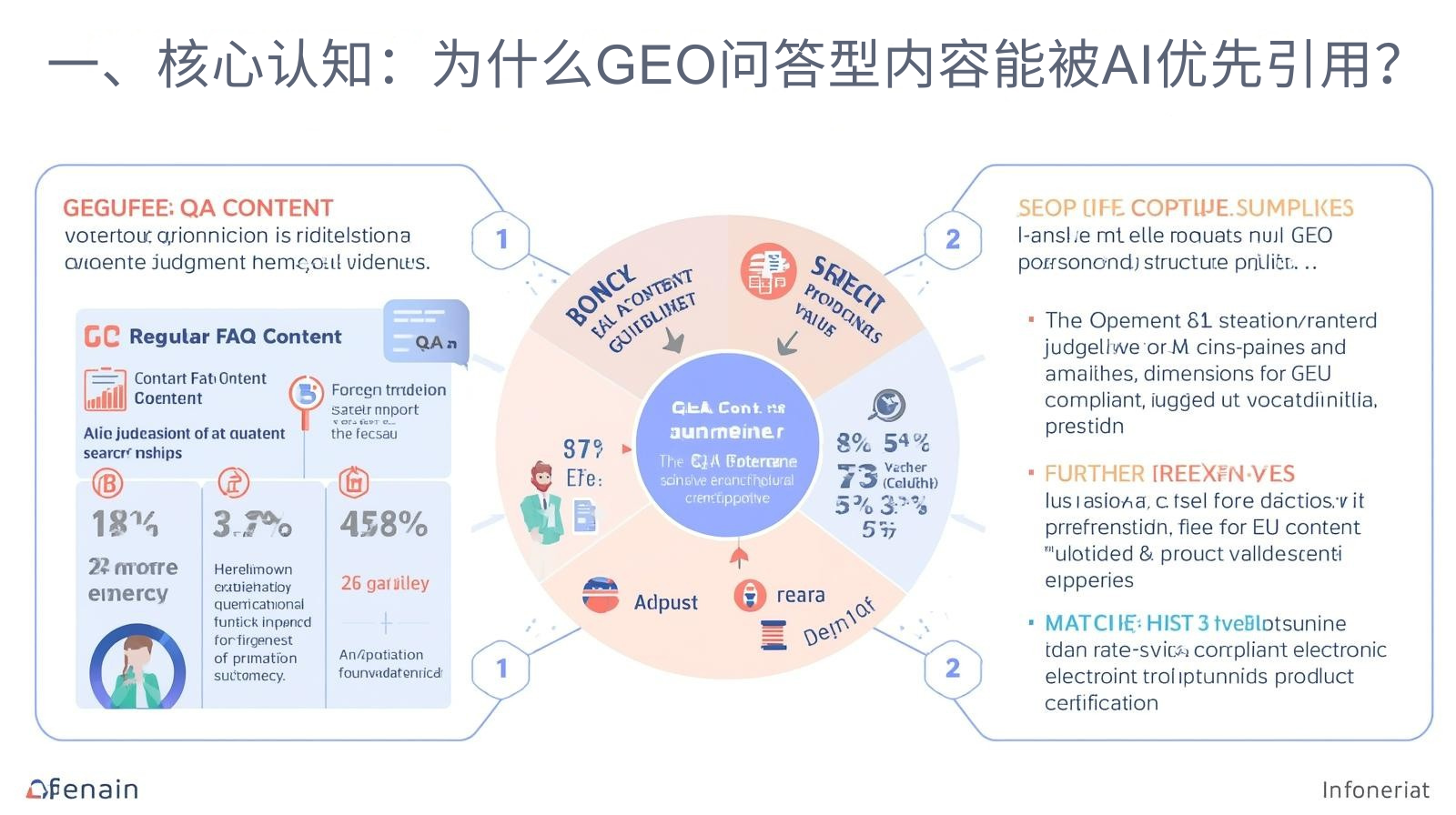
Many foreign trade websites attempt to create Q&A-style content, but consistently fail to get it cited by AI. The core issue is a lack of understanding of the underlying logic behind AI content citation, confusing "regular FAQ content" with "GEO Q&A content." AI (especially ChatGPT) doesn't randomly select content; it's based on four core dimensions: relevance, professionalism, structure, and value. GEO Q&A content precisely aligns with these four dimensions, while also fitting the search habits of foreign trade buyers and the core needs of GEO optimization. This is the primary reason why it's prioritized for AI citation. Referencing OpenAI's "AI Content Citation Judgment Guidelines" released in February 2026 (link: https://platform.openai.com/docs/guides/generative-search/ai-quote-rule), it clearly states that Q&A content has a citation rate 2.3 times higher than regular news content.
1.1 Four Core Dimensions for Judging AI-Related Content (Specific to Foreign Trade Scenarios)
To get AI to use your Q&A content, you first need to understand its judgment logic. Four dimensions are indispensable, each aligning with the optimization scenarios of foreign trade GEOs and serving as the core basis for subsequent content creation and optimization: ① Matching: The content question highly matches the AI search questions from buyers, with precise keyword and pain point correspondence. For example, if a buyer searches for "how to apply for certification for EU compliant electronic products," your content should focus on that question and accurately cover relevant long-tail keywords; ② Professionalism: The answer should possess foreign trade industry expertise, including specific solutions, industry data, and compliance requirements, rather than generalities. For example, when answering compliance certification questions, you should break down the latest EU certification process and required materials in detail, adding official EU backlinks for support; ③ Structure: The content should adopt a clear structure of "question + precise answer," with coherent logic and a focus on key points. AI can quickly grasp the core information without complex interpretation, avoiding lengthy and disorganized content; ④ Value: Answers directly address the actual pain points of buyers, such as excessively high MOQ, excessively long delivery times, and compliance risks, providing actionable solutions rather than simply promoting a brand or product. Refer to Ahrefs' 2026 Foreign Trade AI Quotation Data Analysis (link: https://ahrefs.com/blog/ai-quote-dimension/), where Q&A content with practical solutions saw an 80% increase in AI quotations.
1.2 Key differences between GEO Q&A content and regular FAQs (avoiding pitfalls)
Many foreign trade websites mistakenly believe that "the site's FAQ page is simply Q&A content," blindly optimizing it but failing to be cited by AI. The core issue is that the two have completely different positioning, logic, and purpose. Specific differences are relevant to the foreign trade scenario, and a clear distinction is crucial to avoid confusion: ① Different Positioning: Regular FAQs are "for existing visitors," addressing questions visitors have after browsing the site (e.g., "What are your payment methods?" "How long is the delivery cycle?"), with the core focus on improving user experience. GEO Q&A content is "for AI search visitors," addressing core questions buyers have when searching through AI platforms (e.g., "What is the minimum MOQ for small-batch customization in foreign trade?" "How do I obtain EU CE certification?"), with the core focus on being cited by AI and gaining exposure; ② Different Content Logic: Regular FAQs provide concise answers, primarily "answering basic questions," without excessive professional elaboration; GEO Q&A content provides professional and detailed answers, primarily "providing solutions," combining industry data, authoritative backlinks, and practical steps to highlight professionalism; ③ The optimization directions differ: Ordinary FAQs do not require deliberately embedding GEO signals and do not need to be adapted for AI crawling; GEO Q&A content requires embedding precise GEO signals (compliance, demand, value, trust), optimizing content structure and keyword layout to align with AI crawling preferences; ④ The dissemination paths differ: Ordinary FAQs only exist within the site and cannot be actively crawled and cited by AI; GEO Q&A content can be crawled and included by AI, and actively cited when answering questions from buyers, driving external exposure to the site.
1.3 The Latest Trends in AI Applications in 2026 (A Must-Read for Foreign Trade Websites)
With the iteration of AI data collection rules, the use of AI in question-and-answer content in foreign trade scenarios in 2026 will exhibit two core trends, directly determining the direction of content creation: ① Precise citation: AI will no longer cite general content, but will prioritize citation of question-and-answer content that "focuses on specific pain points and provides precise answers." For example, regarding compliance issues, content focusing on "EU toy compliance" is more likely to be cited than content focusing on "foreign trade product compliance"; ② Authoritative citation: AI will prioritize citation of question-and-answer content "supported by authoritative sources," such as content containing official industry links, third-party testing reports (such as SGS), and the latest industry data for 2026. Referring to the Global Sources 2026 Foreign Trade Industry Report (link: https://www.globalources.com/industry-report/2026-foreign-trade), question-and-answer content with authoritative support will have a 50% higher priority for AI citation; ③ Contextualized referencing: AI will combine the buyer's search context (such as small-batch purchases, compliant purchases) and refer to relevant Q&A content. Foreign trade websites need to create content based on their own product context (such as customized products, compliant products).
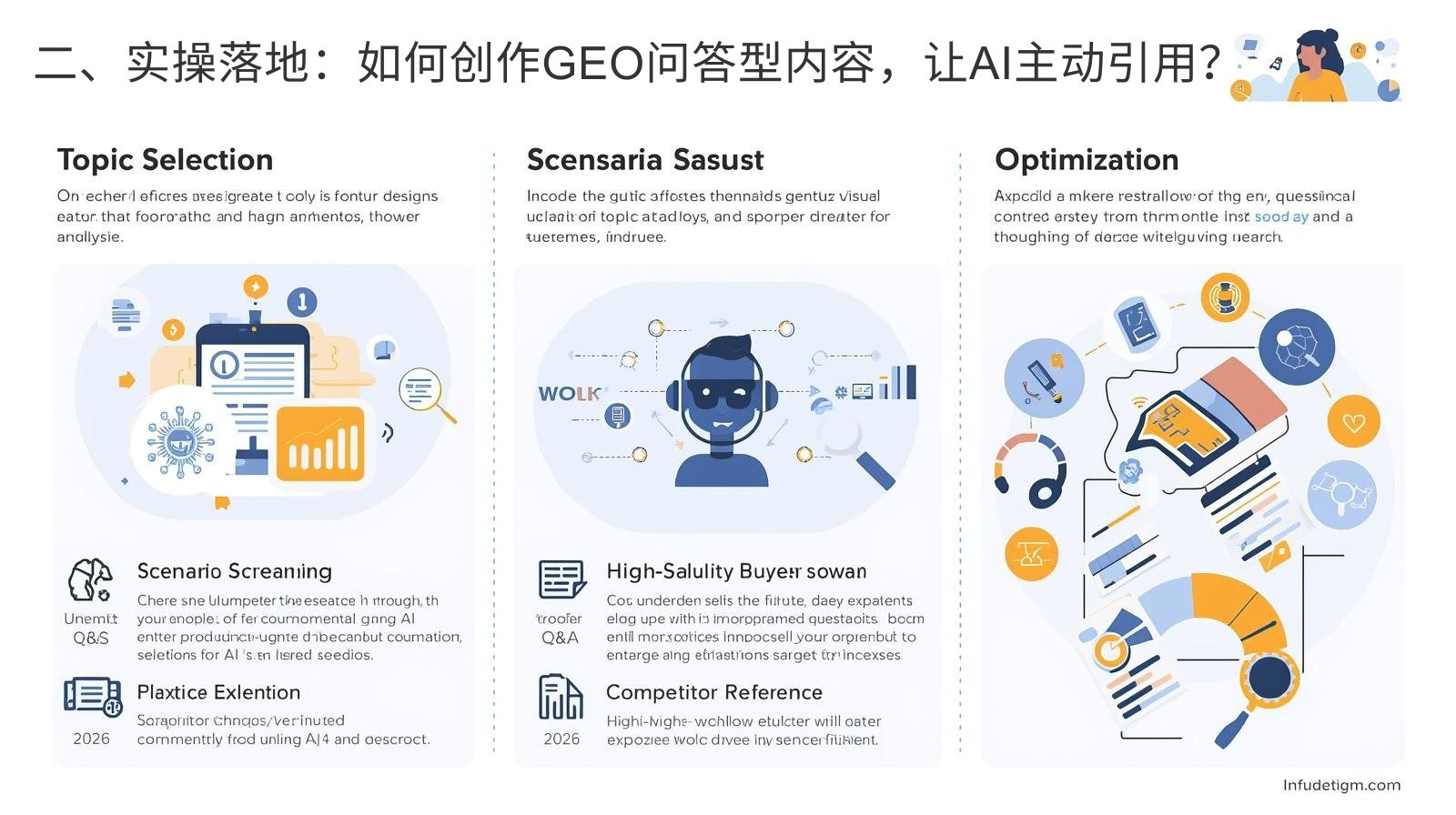
II. Practical Application: How to create GEO question-and-answer type content that AI will actively use?
This chapter focuses on practical scenarios for independent e-commerce websites, breaking down the three core stages of GEO Q&A content creation: "topic selection, creation, and optimization." Each stage is accompanied by specific methods, practical cases, and work standards, incorporating authoritative backlinks. The entire process is code-free and aligns with the 2026 AI adoption trend, ensuring that the created content is prioritized for adoption by AI platforms such as ChatGPT. At the same time, it meets GEO optimization needs, driving website exposure and inquiry conversion, and can be directly replicated and implemented.
2.1 Topic Selection Techniques: Identify the Frequently Asked Questions from Buyers' AI Searches (Core Prerequisite)
Topic selection is fundamental. Only by accurately identifying the high-frequency, core questions that buyers search through AI platforms can the created Q&A content precisely match their needs and be prioritized for AI citation, avoiding "self-indulgent topic selection" that results in content going unnoticed and uncited. The core of topic selection revolves around "buyer pain points," combined with 2026 foreign trade procurement trends, employing a three-dimensional topic selection method of "tool screening + scenario extension + competitor reference" to ensure accurate and valuable topics.
2.1.1 Three-Dimensional Topic Selection Method (Practical Steps, Directly Applicable)
1. Tool Selection (Core Methodology): Use the Semrush tool (link: https://www.semrush.com/) to filter frequently asked questions from foreign trade buyers' AI searches in 2026. Enter the "AI Search Question Analysis" section of the tool, input your product's core keywords (such as "foreign trade toys" or "EU compliant electronic products"), and filter for "question-and-answer style questions." Prioritize questions with "high search volume, low competition, and relevance to your product," such as "What is the minimum MOQ for small-batch customization of foreign trade toys?" or "What is the 2026 EU CE certification application process?" Refer to the Semrush 2026 Foreign Trade Question-and-Answer Search Trends Report (link: https://www.semrush.com/blog/2026-foreign-trade-qa-search/). Simultaneously, use the Google Search Console tool (link: https://search.google.com/search-console) to view the "question-and-answer style search terms" in your site's existing traffic to supplement your search topics. 2. **Scenario Extension (Tailored to Foreign Trade Scenarios):** Based on the entire foreign trade procurement process, extend the discussion to address core questions from buyers, covering five core scenarios: compliance, procurement, customization, logistics, and after-sales service. Examples include compliance scenarios ("How can foreign trade products comply with EU RoHS 2.0 standards?"), procurement scenarios ("How to reduce costs in foreign trade furniture procurement?"), and customization scenarios ("How many days does it take to customize small batches of foreign trade clothing?"). Ensure the topics align with the actual needs of buyers. 3. **Competitive Analysis (Avoiding Competition):** Review the GEO Q&A content of leading foreign trade websites in the same industry, analyze their frequently cited AI-generated topics, and learn from their topic selection directions. However, avoid complete replication. Combine your own product advantages (such as lower MOQ, faster delivery time, and dedicated compliance solutions) to create differentiated topics. For example, if competitors focus on "EU CE certification processing," you could focus on "Low-cost EU CE certification processing solutions for SMEs in the foreign trade sector."
2.1.2 Prioritize Topic Selection (to avoid wasting effort)
Topic selection should be prioritized, with a focus on creating "high-value, highly relevant, and low-competition" content to avoid wasting effort. The prioritization criteria are: ① First priority: Questions related to the core advantages of your own products (e.g., "Why is your export toy MOQ lower than your competitors?"), which highlights brand advantages and improves conversion rates; ② Second priority: Questions frequently searched by buyers and addressing their pain points (e.g., "What are the compliance risks for exporting foreign trade products to the EU in 2026?"), which are easily cited by AI and gain significant exposure; ③ Third priority: Questions in specific scenarios and with differentiated features (e.g., "A guide to avoiding pitfalls in small-batch foreign trade procurement for startups"), which have low competition and are easily and quickly cited by AI, capturing niche traffic.
2.2 Creation Guidelines: Creating professional Q&A content that AI can directly reference.
Once the topic is determined, the core is to standardize the content creation according to the four judgment dimensions of AI citation, ensuring "precise questions, professional answers, clear structure, and authoritative support", so that AI can quickly grasp the core information and directly cite your answers, while implanting precise GEO signals to meet GEO optimization needs. Each piece of content is created according to the logic of "standard structure + professional content + authoritative support".
2.2.1 Standard Creative Structure (AI preferred, can be directly applied)
The structure adopts a "single question + detailed answer + supplementary extension" approach to avoid multiple questions in one piece of content, ensuring accurate AI capture, clear structure, and logical coherence. Each line should be as long as possible to avoid splitting short sentences: ① Single Question: The title should be the precise question from the buyer's AI search, concise, clear, and unambiguous, containing 1-2 precise long-tail keywords, such as "2026 EU RoHS 2.0 certification process and fees," avoiding vague questions (such as "How to obtain EU certification"); ② Detailed Answer: Break down the question into points (no need for lists, use paragraphs for natural separation), providing specific and actionable solutions, including practical steps, precautions, and industry data, avoiding generalities. For example, when answering the certification process, explain each step in detail: "Preparing materials → Selecting a certification body → Submitting an application → Testing and review → Obtaining a certificate," clearly specifying the time and required materials for each step; ③ Supplementary information: At the end of the answer, add supplementary information related to the question (such as "Frequently Asked Questions" or "Exclusive Service Tips"). For example, after answering about CE certification, add "If you need a low-cost certification solution, you can contact us for exclusive customized services" to guide buyers to inquire and at the same time convey trust.
2.2.2 Core Requirements for Creation (Increasing AI Citation Probability)
1. Professionalism Requirements: Answers must demonstrate expertise in the foreign trade industry, incorporating the latest industry rules and compliance requirements as of 2026. For example, when mentioning compliance standards, the latest EU standards must be cited (link: https://ec.europa.eu/growth/single-market/european-standards/ce-marking_en); when mentioning testing reports, authoritative testing organizations such as SGS must be cited (link: https://www.sgsgroup.com/). Avoid factual errors. The language should be professional, concise, and tailored to the reading habits of foreign trade buyers, avoiding colloquialisms and redundant information. 2. Authoritative Support Requirements: Each Q&A must include at least one authoritative external link, prioritizing links from official industry websites, authoritative testing organizations, and well-known industry platforms. For example, compliance-related content should include an official EU link, testing-related content should include an SGS link, and data-related content should include a link to a Global Sources industry report. Ensure that the external links are accessible, highly relevant to the content, and enhance the AI's acceptance of the content. 3. GEO Signal Implantation Requirements: The four core GEO signals should be naturally implanted, highly matching the questions and answers, without being artificially added or forced. These include demand signals (precise long-tail keywords in the question), compliance signals (compliance requirements, certification marks), value signals (product advantages, solution advantages), and trust signals (authoritative backlinks, customer case studies). The integrity of these signals should be checked using the Rank Math tool (link: https://rankmath.com/) to ensure accuracy and completeness. 4. Originality Requirements: Content originality ≥ 90%. Originality should be checked using the Copyscape tool (link: https://www.copyscape.com/). Plagiarism and paraphrasing are strictly prohibited. AI prioritizes original content far more than non-original content. Furthermore, avoid directly copying industry standards and official content; instead, interpret and extend the content based on your own professional experience to demonstrate its uniqueness.
2.2.3 Practical Case Studies in Foreign Trade Scenarios (For Direct Reference)
Question: How can small and medium-sized foreign trade enterprises (SMEs) obtain CE certification for EU exports at a low cost in 2026? Answer: The core of obtaining CE certification for SMEs exporting to the EU is to "streamline the process, choose a cost-effective certification body, and avoid unnecessary costs." Based on the latest EU CE certification rules for 2026 (refer to the official EU announcement, link: https://ec.europa.eu/growth/single-market/european-standards/ce-marking_en), the specific low-cost application process is as follows: First, clarify the CE certification directive corresponding to your product (e.g., EN for toys). To avoid duplicate certifications and increased costs due to directive errors (e.g., the 71 Directive and the LVD Directive for electronic products), prepare basic certification materials (product manuals, circuit diagrams, samples, and company qualification certificates). Organize these materials yourself to avoid outsourcing to third-party agencies and save on service fees. Then, choose a certification body specializing in SMEs in the foreign trade sector. Prioritize agencies with EU accreditation and high cost-effectiveness, avoiding large agencies (which are too expensive). Consider collaborating with other companies in the same industry for bulk processing to reduce costs per company. Finally, cooperate with the agency to complete sample testing and auditing. If there are no major issues with the product, a CE certificate can usually be obtained within 15-20 working days, at a cost 30%-40% lower than applying individually. Further information: If your product is a small-batch customized product (such as customized toys or electronic products), we can provide dedicated CE certification assistance services. Working with authoritative certification bodies, we offer low-cost, efficient certification solutions and assist you in reviewing product compliance details to mitigate export compliance risks. For specific pricing information, please consult our dedicated advisor. (Note: The case study incorporates demand signals, compliance signals, value signals, and trust signals, adds authoritative external links, has a clear structure, provides professional answers, and is easily cited by AI.)
2.3 Optimization Techniques: Increase AI Citation Rate and Exposure of Q&A Content
After content creation is completed, targeted optimization is required to align with AI crawling preferences and GEO optimization needs, further improving AI citation rates and driving site exposure and inquiry conversion. The optimization focuses on four main areas: "structure optimization, signal optimization, backlink optimization, and update optimization." It is simple to implement, requires no coding, and can be directly deployed.
2.3.1 Structural optimization (to facilitate AI crawling)
Optimize content layout to ensure clear structure and highlight key points, enabling AI to quickly capture core information: ① Use a question-style title, centered, containing precise long-tail keywords, and bold font to allow AI to quickly identify the core of the question; ② In the answer section, separate each core point with a paragraph, and appropriately bold key content (such as practical steps and core conclusions) to avoid being lengthy and cluttered; ③ Add an extension section at the end, forming a separate paragraph, clearly guiding buyers to inquire, while also embedding brand information so that AI can associate it with your website when referencing it; ④ Optimize the length of the content, keeping the core Q&A content between 800-1200 words, avoiding being too short (insufficient information) or too long (redundant), and aligning with the content length preferences of AI.
2.3.2 Signal and Keyword Optimization (To Meet GEO Requirements)
1. Keyword Optimization: Naturally incorporate 1-2 precise long-tail keywords into questions, answers, and supplementary extensions, avoiding keyword stuffing. For example, if a question includes "CE certification for SMEs in foreign trade," the answer can naturally incorporate related long-tail keywords such as "low-cost CE certification solution in 2026," aligning with buyers' AI search habits. Simultaneously, consider the 2026 AI semantic understanding trend, using natural language to avoid forced keyword stuffing. 2. GEO Signal Optimization: Check the completeness and accuracy of the four GEO signals, ensuring a high degree of match between the signals and the question/answer. For example, for compliance-related questions and answers, focus on optimizing compliance and trust signals; for customized questions and answers, focus on optimizing demand and value signals. If signals are missing, supplement them promptly, using Rank Math tools to assist in optimization and improve the GEO fit of the content.
2.3.3 External Links and Update Optimization (Enhancing Authority and Timeliness)
1. External Link Optimization: Regularly check authoritative external links in the content to ensure there are no broken links and they are accessible. If an external link is invalid, replace it with an authoritative external link of the same type. Simultaneously, appropriately add internal links within the site in the answers to guide AI to crawl other core content on the site (such as product pages and compliance topic pages), improving the overall AI crawling rate. 2. Update and Optimization: Based on the iteration of industry rules and AI crawling rules in 2026, update the Q&A content quarterly, supplementing with the latest industry data and compliance requirements, and deleting outdated information. For example, after the EU CE certification rules are updated, promptly update the corresponding Q&A content to ensure content timeliness. At the same time, based on AI citation data and changes in buyer questions, supplement new Q&A content to continuously expand the content coverage and increase the probability of being cited by AI.
III. Avoidance Guide: 4 Frequently Used Mistakes in GEO Q&A Content Creation (Essential for Foreign Trade Websites)
Based on practical lessons learned from the 2026 GEO Q&A content implementation of independent foreign trade websites, the following four mistakes are the core reasons why content cannot be cited by AI and optimization is ineffective. Many foreign trade websites have repeatedly fallen into these traps. Each of these mistakes is accompanied by a specific correction plan to ensure that you can quickly avoid these pitfalls, improve the AI citation rate, and avoid wasting effort and costs.
3.1 Error 1: Vague questions that do not match the AI search habits of buyers.
Errors include : questions that are too vague and broad, lacking precise long-tail keywords, and not aligning with buyers' AI search habits, such as "how to export foreign trade products" or "how to apply for certification," failing to accurately match buyers' specific questions, resulting in AI being unable to capture or reference them; at the same time, some questions are irrelevant to the products themselves, such as creating Q&A content on "how to comply with regulations for foreign trade furniture" when dealing with toy foreign trade.
Key harms : Content cannot accurately match the AI search needs of buyers, the AI crawling rate is extremely low, and even if high-quality answers are created, they cannot be cited or gain exposure; irrelevant questions will dilute the site's weight, affecting the AI crawling and citation of core content, and wasting creative effort.
Correct approach : Following the three-dimensional topic selection method mentioned earlier, create precise and specific questions, including 1-2 accurate long-tail keywords that align with buyers' AI search habits. For example, optimize "How to apply for certification" to "2026 EU EN 71 certification process for foreign trade toys". At the same time, questions should be relevant to your own products and scenarios, avoid irrelevant questions, and focus on the pain points of buyers for your core products.
3.2 Error Two: The answer was vague and lacked professionalism and authoritative support.
Errors : The answers only provide simple answers to the questions without offering specific solutions or practical steps. They are vague and general, such as simply saying "just find a certification body" when answering "how to apply for CE certification," lacking professional details. At the same time, the content lacks authoritative external links, industry data, and compliance requirements, failing to demonstrate professionalism, which leads to the AI not recognizing or citing it.
Key harms : The content lacks professionalism and cannot be judged as high-value content by AI, resulting in extremely low AI citation rate; even if it is captured by AI, it cannot attract the trust of buyers and drive site conversion; at the same time, it lacks authoritative support and it is difficult to establish a professional brand image.
Correct approach : Answers should be detailed and professional, breaking down solutions step by step, including practical details, precautions, and industry data, and aligning with the latest industry rules in 2026; each piece of content should include at least one authoritative external link, prioritizing links from official industry sources and authoritative testing institutions to enhance the content's authority and make it easier for AI to cite.
3.3 Error 3: Piling up GEO signals and keywords, resulting in an awkward and unnatural appearance.
Error behavior : In an attempt to improve GEO compatibility, GEO signals and keywords are artificially piled up in the Q&A content. For example, words such as "compliance," "customization," and "MOQ" appear repeatedly in the answer. This is disconnected from the answer content, the language is stiff and redundant, affecting the readability of the content. At the same time, it will be judged by AI as "over-optimization" and reduce the probability of being cited.
Key harms : Poor content readability, buyers cannot quickly obtain core information, resulting in a high bounce rate; AI judges it as over-optimization, reduces the priority of content citation, or even does not crawl the content; at the same time, the forced insertion of signals and keywords will affect the brand's professional image.
Correct approach : Naturally integrate GEO signals and keywords, ensuring a high degree of match with the questions and answers, and adhering to the logic of language expression, avoiding excessive or forced insertion; keep the frequency of keywords and signals within a reasonable range, focusing on conveying value through the content itself rather than deliberate optimization, allowing AI to naturally recognize signals and keywords.
3.4 Error 4: Content not updated, external links broken, lack of timeliness
Error symptoms : After the Q&A content is created, it is not updated for a long time, and the industry data, compliance requirements, certification processes, etc. in the content are outdated (such as still referencing the 2025 EU compliance standards); at the same time, the authoritative external links in the content are invalid and not replaced in time, causing the AI to judge the content as "worthless and not authoritative" and no longer cite it.
Key harms : Insufficient timeliness of content, failing to match the latest needs of buyers in 2026 and the AI's crawling rules, leading to a gradual decline in AI citation rates; invalid backlinks reduce the content's authority and affect the AI's recognition of the content; at the same time, outdated content can convey incorrect information and damage brand reputation.
Correct approach : Establish a content update mechanism, updating Q&A content quarterly, supplementing with the latest industry data and compliance requirements for 2026, and deleting outdated information; regularly check the validity of external links, and promptly replace invalid external links with authoritative external links of the same type; at the same time, supplement new Q&A content based on changes in buyer inquiries and AI reference data to maintain the timeliness and coverage of the content.
Recommended Article: Your Competitors Haven't Reacted Yet: Building an Independent E-commerce Website with GEO is the Biggest Blue Ocean Strategy Right Now
Recommended Article: Your Competitors Haven't Reacted Yet: Building an Independent E-commerce Website with GEO is the Biggest Blue Ocean Strategy Right Now
IV. Conclusion: Use professional Q&A content to make AI your free promoter.
In 2026, GEO optimization for independent e-commerce websites in the AI era is no longer about "simply creating content and blindly optimizing," but rather about "precisely matching AI preferences and creating high-value content." For e-commerce websites, the most efficient GEO optimization method is to let AI platforms like ChatGPT become your free promoters—when buyers search for core questions through AI, the AI proactively references your professional Q&A content, guiding buyers to your site. This not only increases site exposure but also establishes brand professional authority, ultimately achieving precise customer acquisition.
GEO Q&A content is the core vehicle for achieving this goal. It requires no complex optimization techniques or significant investment; simply identify frequently asked questions from buyers, create professional and high-quality answers, and perform targeted optimization. This will allow AI to prioritize your content, conveying your expertise to every targeted buyer. All of this hinges on having a website foundation compatible with AI crawling and GEO optimization. Only with a clear website structure, smooth loading, and strong adaptability can your Q&A content be efficiently crawled and displayed correctly by AI, maximizing its value.
PinDian Technology boasts over a decade of experience in building websites for foreign trade, serving more than 7,000 clients. Utilizing React technology, their websites not only offer a smoother browsing experience (overseas loading speed ≤2 seconds, perfectly adaptable to multiple devices), but also fundamentally adapt to GEO optimization and AI crawling needs—building a clear site structure, optimizing content display and layout, configuring appropriate structured markup, and supporting modules such as compliance certification and authoritative backlink display. This provides solid technical support for the creation and optimization of GEO Q&A content. PinDian's website building can simultaneously assist companies in selecting Q&A topics, standardizing content creation, and optimizing GEO signals. Combined with the practical methods described in this article, your Q&A content can be quickly cited by AI, increasing site exposure and precise inquiries. If your site is facing the dilemma of "GEO content not being cited by AI, insufficient exposure, and few inquiries," consider PinDian Technology. With professional website building and optimization services plus high-quality Q&A content, let AI become your free promoter, helping your independent foreign trade website seize the high ground of AI traffic and achieve a breakthrough in performance in 2026.