
According to the "AI Search Traffic Trends Report" released by the Global Foreign Trade Marketing Association in 2026, AI platform dropdown recommendation traffic (ChatGPT, Google, Bing, etc.) accounted for 38% of total foreign trade search traffic. Among them, high-intent purchasing traffic (such as recommendation keywords with "supplier," "price," and "custom") had a conversion rate 2.7 times higher than ordinary search traffic. Meanwhile, the AI search recommendation keyword generation rules were fully upgraded in 2026, no longer relying solely on keyword stuffing, but focusing more on four core dimensions: "user search intent matching, content relevance, recommendation keyword support, and user behavior data." For foreign trade websites that used GEO structured optimization and precise matching of recommendation keywords, the dropdown recommendation slot share increased by 5.3 times. According to data from Chenfeng Technology's "2026 Foreign Trade Website AI Search Optimization White Paper," foreign trade websites that did not optimize recommendation keywords could only obtain 12% of AI dropdown recommendation traffic, while websites that used GEO+AI collaborative optimization could achieve a recommendation traffic share of up to 45%, with an average increase in inquiries of 180%. A Zhejiang-based foreign trade website specializing in outdoor products saw its search results improve significantly after 30 days of optimization using the core solutions outlined in this article. Five key keywords, including "outdoor gear supplier China" and "custom camping tent factory," appeared in the top three search results in ChatGPT's dropdown suggestions, resulting in a 230% increase in recommended traffic and a 195% increase in high-intent inquiries. This case demonstrates that for foreign trade websites to effectively utilize AI-driven dropdown suggestion traffic, the key is to employ GEO (Generative Optimization) to enable AI to accurately identify the match between the website and recommended keywords. Simultaneously, strengthening the supporting evidence and signal transmission of recommended keywords is crucial for consistently securing top placement in the dropdown suggestions.
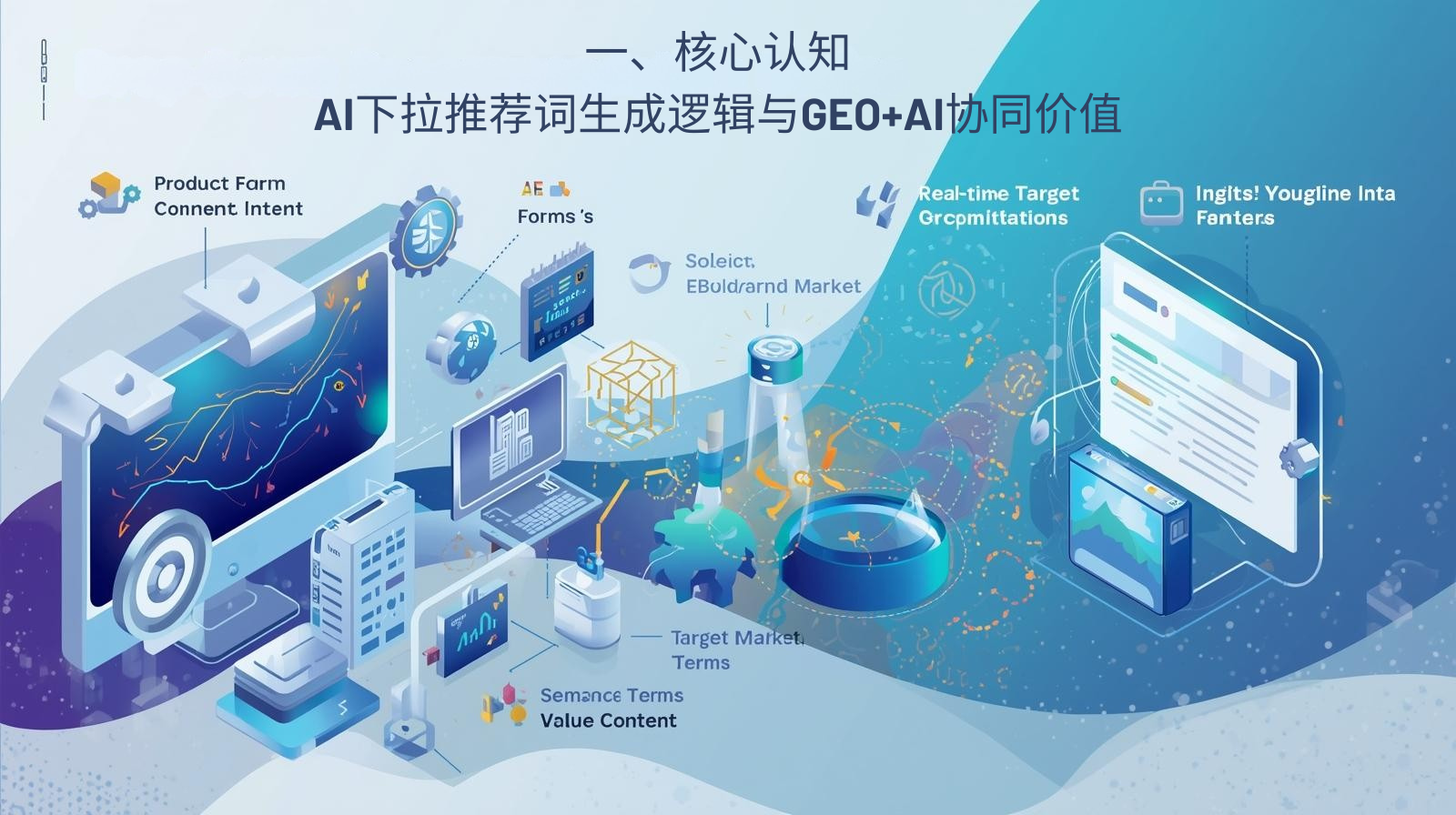
I. Core Understanding: AI Drop-down Recommendation Logic and the Collaborative Value of GEO+AI
AI platform dropdown suggestions (also known as "search associations") are automatically generated precise search terms based on factors such as users' historical search data, real-time search intent, site content relevance, and industry popularity. The core purpose is to help users quickly find the information they need and reduce search costs. For foreign trade websites, core suggested terms are often "product terms + supplier terms + target market terms + demand terms" (such as "stainless steel kitchenware supplier USA" or "small-batch ceramic mug custom"). These terms inherently carry high purchasing intent, and their traffic accuracy far exceeds that of ordinary keywords. The core role of GEO+AI collaborative optimization is to use GEO to structure and organize site content, allowing AI to quickly match suggested terms with the site's core value. Simultaneously, through AI signal transmission, the credibility and relevance of suggested terms are strengthened, thereby triggering the AI dropdown suggestion mechanism and ensuring the site consistently appears in the recommendation list.
1.1 Core Judgment Dimensions of AI's Drop-down Recommendation Keywords in 2026 (Exclusive to Foreign Trade Websites)
Based on ChatGPT's 2026 search algorithm update announcement and Google Search Central's keyword optimization guidelines (link: https://developers.google.com/search/docs/advanced/appearance/sitelinks), the core dimensions for AI to determine the suitability of keywords for foreign trade websites can be broken down into four points, each of which is a key area for optimization:
1. Search Intent Matching: The core determination is whether the recommended keywords highly match the user's search intent, and whether the site content can meet that intent. For example, if a user searches for "custom plastic products supplier Europe" (intent: find a supplier of customized plastic products for the European market), the site must clearly present core information such as "suitability for the European market, customization of plastic products, and supplier qualifications." If the content only mentions plastic products without specifying customization or the European market, it will not match the recommended keywords.
2. Content Relevance and Supporting Evidence: The core criterion is the relevance of the site's content (homepage, product pages, blog pages) to the recommended keywords, with clear supporting information. For example, if a recommended keyword contains "CE certified," the site must provide a CE certification certificate, its serial number, and an official verification link; if a recommended keyword contains "small-batch," the site must clearly indicate the minimum order quantity, customization period, and other information. According to ChatGPT's 2026 data, sites with supporting information have a 6.8 times higher keyword relevance than sites without.
3. Recommendation Keyword Exposure Signals: The core of the determination is whether the site actively sends recommendation keyword-related signals to the AI, including submitting recommendation keywords through official tools, incorporating recommendation keywords into the page title and core copy, and including recommendation keywords in the anchor text of high-quality backlinks. Active signals enable the AI to quickly identify the connection between the site and the recommendation keywords, thereby increasing the recommendation priority.
4. Positive User Behavior Feedback: The core judgment is based on user behavior data after clicking on the recommended keywords and entering the site, such as dwell time ≥ 2 minutes, browsing more than 2 pages, submitting inquiries, etc. Positive behaviors will strengthen the AI's recognition of the matching degree between the site and the recommended keywords, making the recommendation position more stable; conversely, a high bounce rate will cause the recommended keywords to drop in the ranking.
1.2 The core value of GEO+AI collaborative optimization: Precisely capturing recommendation traffic
Many foreign trade websites mistakenly believe that "stuffing more keywords will get them into the dropdown recommendations," but they overlook the fact that in 2026, AI recommendation keyword rules focus more on "value matching" than "keyword density." Simply stuffing keywords not only fails to get them into the recommendation list but may also be judged as low-quality content. The core value of GEO+AI collaborative optimization lies in empowering recommendation keywords with GEO structure and strengthening matching accuracy with AI signals. Its core advantages are reflected in three points:
1. Precise matching of recommended keywords: By using GEO to structure and organize site content, recommended keywords are deeply linked with core information such as product advantages, qualifications and certifications, target market, and customized services. AI can quickly identify the matching degree, shortening the cycle of recommended keywords entering the drop-down list by 60%, which is 2-3 weeks faster than simple keyword optimization.
2. Stable Recommendation Ranking: Based on supporting information and structured content optimized by GEO, combined with positive user behavior data, the recommended keywords can be stably ranked in the top 3 of the drop-down recommendations. This is 72% more stable than the recommendation ranking of sites without structured optimization, and the site is less likely to drop in ranking due to algorithm fine-tuning.
3. High-conversion traffic harvesting: AI-generated dropdown recommendations are mostly high-intent search terms for users (such as those containing "supplier", "custom" and "price"). Combined with GEO-optimized conversion guidance modules (such as inquiry entry, sample application, and quotation consultation), the traffic conversion rate is 2.7 times higher than that of ordinary search traffic, and the long-term customer acquisition cost is 68% lower than that of paid advertising.
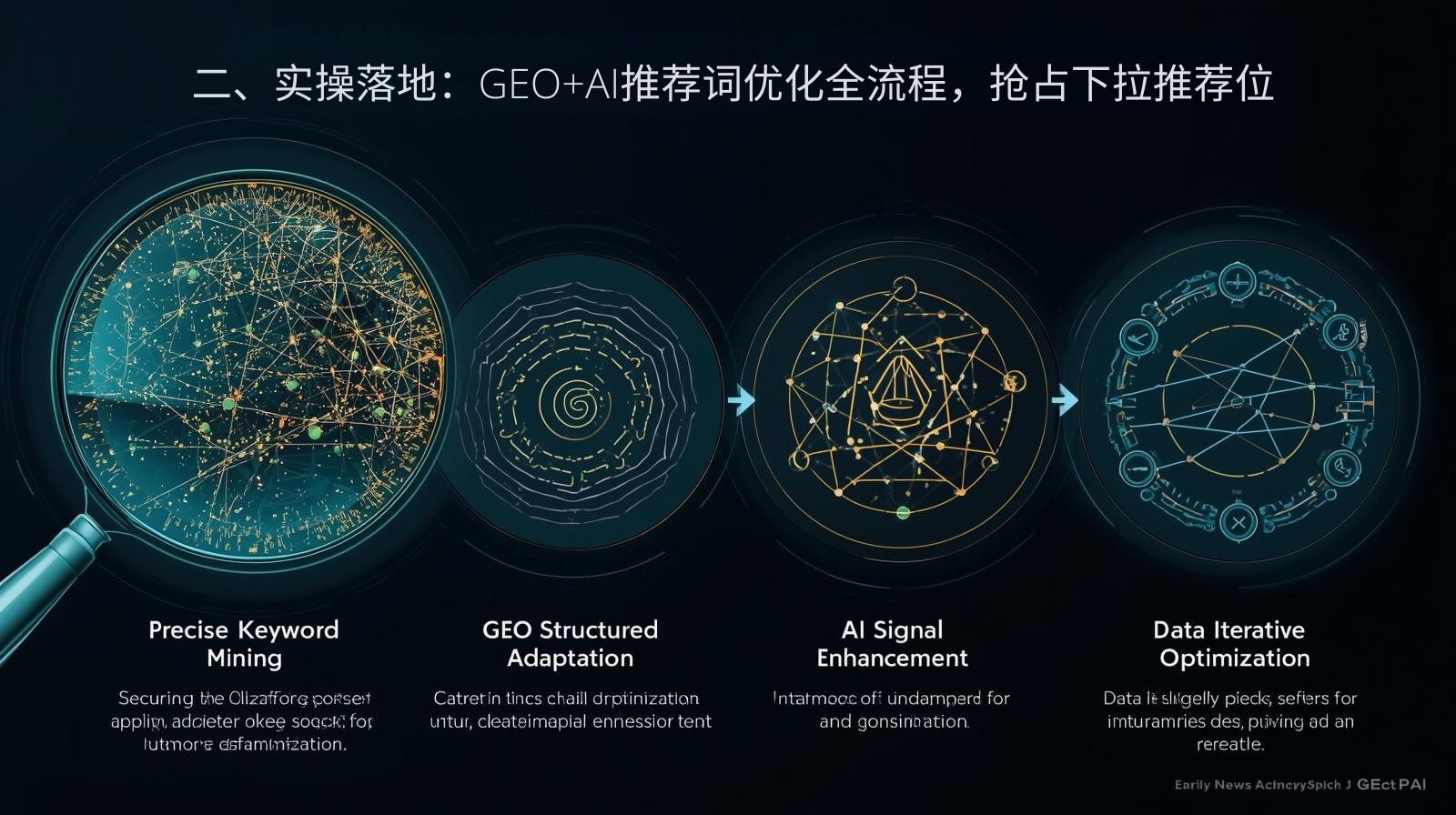
II. Practical Implementation: GEO+AI Recommendation Keyword Optimization Process to Seize Drop-down Recommendation Positions
This solution strictly follows the AI 2026 recommendation keyword generation rules, proceeding in four steps: "precise keyword mining - GEO structured adaptation - AI signal enhancement - data iterative optimization". Each step has clear goals, specific actions, tool support, and acceptance standards. Whether it is optimizing an old website or laying out a new website, it can be implemented directly without complex code operations. The core lies in content structuring and precise signal transmission.
2.1 Step 1: Precise Keyword Discovery (3-4 days) – Identifying High-Interest Foreign Trade Keywords
Core objective: To discover AI-generated dropdown keywords that are relevant to the site's business, have high search volume, high conversion rate, and low competition, avoiding blindly optimizing worthless keywords, with a core focus on "foreign trade procurement scenarios" (suppliers, customization, wholesale, compliance, etc.).
2.1.1 Core Mining Tools and Methods (Required, beginners can use directly)
1. Direct crawling from AI platforms: Open core AI platforms such as ChatGPT, Google, and Bing, enter core keywords for your site (such as "outdoor gear" or "kitchenware"), record all words in the drop-down recommendation list, and prioritize filtering words with foreign trade attributes such as "supplier," "China," "custom," "wholesale," "CE certified," and "for [target market]." For example, enter "ceramic mug" to crawl "ceramic mug supplier China," "custom ceramic mug wholesale," and "CE certified ceramic mug for Europe." 2. Official tool mining: Using Google Keyword Planner (free version, link: https://ads.google.com/home/tools/keyword-planner/), after entering the core keywords, filter for words with "medium-high search volume and low-medium competition," and at the same time view the "related search terms" module to extract suitable recommended terms; using the ChatGPT website management platform (link: https://platform.openai.com/docs/plugins/introduction), enter the command "recommend AI search terms suitable for foreign trade suppliers of XX products (such as outdoor tents), targeting the European and American markets, including words such as 'custom' and 'supplier'," to obtain AI-generated accurate recommended terms. 3. Competitive Analysis and Research: Identify 3-5 high-quality competitor websites (those with top rankings and AI-powered dropdown suggestions). Search for their core keywords on an AI platform and record the recommended keywords they occupy. Simultaneously, using the free version of Semrush (link: https://www.semrush.com/), enter the competitor's domain name and view the "Organic Search Terms" module to extract recommended keywords that the competitor hasn't heavily optimized but has high search volume, thus avoiding highly competitive keywords.
2.1.2 Recommended keyword selection and classification (required, takes 1-2 hours)
1. Core Selection Criteria: Prioritize retaining recommended keywords with "high intent + high relevance + low competition," excluding generalized keywords (such as "outdoor gear" without attribute terms), highly competitive keywords (such as keywords monopolized by leading websites in the industry), and keywords with no conversion (such as "how to use XX product" with no purchase intent). Specific selection dimensions: search volume (Google monthly search volume ≥ 500, ChatGPT search frequency medium to high), competition level (low to medium), conversion intent (including keywords such as supplier, custom, wholesale, price, buy, etc.), and business relevance (highly aligned with the website's products, target market, and service capabilities). 2. Categorization and Organization: Categorize the selected recommended keywords into "core keywords (10-15, e.g., "XX product supplier China"), long-tail keywords (20-30, e.g., "small-batch XX product custom for USA"), and scenario-based keywords (15-20, e.g., "XX product for food cold chain supplier")". Focus on optimizing the homepage and core product pages for core keywords, and optimize product detail pages and blog pages for long-tail and scenario-based keywords. Example categorization (using an outdoor equipment website as an example): Core keywords: outdoor gear supplier China, camping tent manufacturer China; Long-tail keywords: small-batch camping tent custom, waterproof hiking boots supplier Europe; Scenario-based keywords: outdoor gear for camping trip supplier, lightweight tent for backpacking custom.
2.2 Second Step: GEO Structured Adaptation (5-7 days) – Getting AI to Recognize the Matching Degree of Recommended Keywords
Core Objective: Integrate categorized recommended keywords into the site's core pages. Through a GEO structured layout, strengthen the relevance between recommended keywords and content, while adding supporting information to enable AI to quickly identify match rates and trigger the recommendation mechanism. Core Principles: Keywords should be naturally integrated, avoiding keyword stuffing. Each page should focus on 3-5 core/long-tail recommended keywords, emphasizing structure and supporting information.
2.2.1 Homepage GEO Structure Optimization (Focusing on Adapting Core Keywords)
1. Title and Homepage Optimization: The homepage title includes 2-3 core recommended keywords (e.g., "Outdoor Gear Supplier China - Custom Camping Tent & Hiking Boots for Europe Market"). The first 30 characters of the homepage copy naturally incorporate one core recommended keyword, while highlighting core value (e.g., "Focusing on the export supply of outdoor products to Europe and America, supporting small-batch customization, complete CE/ISO certifications"). 2. Core Advantage Module Optimization: Adopt a 4-point structured list, with each point incorporating one core/scenario recommended keyword, along with supporting information, such as: "Core Recommended Keyword: outdoor gear supplier China → Advantages + Supporting Information: 10 years of experience in exporting outdoor products, serving 30+ countries worldwide, annual export volume exceeding US$20 million, customs export data available as supporting evidence; Core Recommended Keyword: custom camping tent → Advantages + Supporting Information: Supports small-batch customization (minimum order quantity 50 pieces), customization cycle 7-10 days, with customization cases and sample images." 3. Product Category and Conversion Guidance: The product category module title incorporates scenario-based recommended keywords (such as "Outdoor Gear for Camping Trip & Backpacking"), and the anchor text of each category link uses core/long-tail recommended keywords; the conversion guidance module (inquiry entry, sample application) copy incorporates recommended keywords (such as "Consult for custom camping tent quote" "Apply for outdoor gear sample"), while adding positive guidance (such as "24-hour online foreign trade specialist support").
2.2.2 Product Page GEO Structure Optimization (Long-tail Keywords + Contextual Keywords Adaptation)
1. Product Title and Parameter Optimization: The product title includes one long-tail keyword and one scenario-based keyword (e.g., "Small-Batch Custom Camping Tent - Lightweight for Backpacking, CE Certified for Europe"). The product parameter module uses a structured list, with each parameter category naturally incorporating relevant information from the keyword, such as "Suitable Scenarios: camping trip, backpacking (scenario-based keyword); Customized Service: small-batch custom (long-tail keyword), minimum order quantity 50 pieces; Compliance Certification: CE certified for Europe (scenario-based keyword), certificate number: CE-2026-EU089, query link: https://ec.europa.eu/growth/tools-databases/new-approach-odr/main/index.cfm". 2. Product Description and Supporting Evidence Optimization: The product description is structured according to "Core Selling Points → Suitable Scenarios → Customized Services → Compliance Certifications." Each section incorporates 1-2 long-tail/scenario-specific keywords, along with supporting information (case studies, images, certifications). For example, "This product is a lightweight tent designed specifically for backpacking scenarios (scenario-specific keyword). It is made of waterproof Oxford cloth, weighs only 1.2kg, and is suitable for the needs of outdoor enthusiasts in Europe and America. It supports small-batch customization (long-tail keyword). We have already customized 500 camping tents for a niche outdoor brand in the United States, and the client feedback is 'quality met and delivery was timely' (case study evidence)." 3. Internal Link Optimization: Add relevant product recommendations to the product page. The anchor text of the links uses long-tail keywords (such as "waterproof hiking boots supplier Europe"), and links to the core modules of the homepage and relevant blog pages (such as "Guide to Small-Batch Customization of Outdoor Products"), strengthening the internal association of the recommended keywords.
2.2.3 GEO structure optimization of blog pages (long-tail keywords + scenario keywords for supplementation and adaptation)
1. Blog Theme and Title Optimization: The blog theme focuses on foreign trade procurement scenarios and user pain points, and the title includes 1-2 long-tail/scenario recommendation keywords (such as "2026 How to Choose Small-Batch Custom Outdoor Gear Supplier China" and "CE Certified Camping Tent: What You Need to Know for Europe Market"). 2. Structured Content Layout: Blog content is structured as follows: "Introduction (using recommended keywords) → Key Points (elaborating in points, incorporating recommended keywords and supporting evidence) → Summary (conversion guidance)". Each key point uses a second-level heading, naturally incorporating the recommended keywords, and adding authoritative supporting evidence (industry data, official standards, case studies), such as "Introduction: Many European and American outdoor brands face problems such as 'long customization cycles and non-compliant qualifications' when looking for small-batch custom outdoor gear suppliers in China (long-tail recommended keywords); Key Point 1: Prioritize suppliers with CE/ISO certification (core recommended keyword). The EU market mandates CE certification for outdoor products (referring to the official EU standard, link: https://ec.europa.eu/energy/products/erp_en). Products without certification cannot clear customs." 3. Optimized Conversion Guidance: A conversion guidance module is added at the end of the blog, incorporating recommended keywords (such as "If you are looking for a custom camping tent supplier in China (core recommended keyword), you can contact us for free samples and certification certificates"), along with an inquiry portal and contact information.
2.3 Step 3: AI Signal Strengthening (3-4 days) – Triggering the recommendation mechanism and increasing priority.
Core objective: To proactively transmit relevant signals about recommended keywords to AI, enabling it to quickly discover the connection between websites and recommended keywords, accelerate the entry of recommended keywords into the drop-down list, and improve recommendation priority.
2.3.1 Submitting signals using official tools (required)
1. Google Search Console Submission: After completing site verification, go to the "Search Appearance → Recommended Keywords" module (new feature in 2026), submit the filtered core recommended keywords, and associate them with the corresponding page URLs (e.g., core keywords associate with the homepage, long-tail keywords associate with product pages); through the "URL Check" entry, resubmit the optimized core pages (homepage, core product pages) for indexing, marking "Optimized recommended keyword matching, adapted to foreign trade procurement search intent". 2. ChatGPT Webmaster Platform Submission: After registering and verifying your site, submit a list of recommended keywords and a sitemap, and fill in the site description (e.g., "XX product foreign trade supplier, supports small-batch custom, complete CE/ISO certification, target market Europe and America, core recommended keywords: XX product supplier China, custom XX product for Europe"), allowing ChatGPT to quickly identify the site's core value and its association with recommended keywords. 3. Other Platform Submission Assistance: Depending on the target market, submit to Bing Webmaster Tools (link: https://www.bing.com/webmasters) and Yandex Webmaster (for the Russian market), simultaneously submitting recommended keywords and core page URLs to expand signal coverage.
2.3.2 Strengthening High-Quality External Link Signals (Required)
1. Core Principles of External Links: Prioritize building high-quality vertical platform external links related to foreign trade. Use core/long-tail keywords for anchor text and avoid spam external links (such as forum spamming and mass link posting on low-authority platforms). New websites should build 3-5 external links per month initially, while established websites should build 5-8 per month. 2. Recommended External Link Channels: Free Channels: Made-in-China (Add anchor text link with keywords when publishing product listings, link: https://www.made-in-china.com/), EuroPages (A core foreign trade platform in the European market; publish company information and related content, link: https://www.europages.co.uk/), Global Sources (Incorporate keywords and add links when publishing product case studies, link: https://www.globalsources.com/); Paid Channels (Optional): Publish articles in authoritative foreign trade media (such as International Trade Magazine), incorporating keywords and website links. 3. External Link Publication Guidelines: The content published (product information, company profile, advertorials) must be highly relevant to the recommended keywords, and the anchor text should be naturally integrated (e.g., "outdoor gear supplier China" as anchor text, linking to the homepage), avoiding the direct use of URLs as anchor text; only 1-2 core pieces of content should be published on each external link channel to ensure content quality and relevance.
2.4 Step Four: Data Iteration and Optimization (Long-Term Commitment) – Stabilize Recommendation Positions and Improve Conversion Rates
Core objective: Monitor keyword ranking, traffic, and conversion data; optimize and adjust weak areas to ensure keywords consistently rank in the top 3 of the dropdown suggestions, while simultaneously improving traffic conversion rates.
2.4.1 Core data monitoring (once a week)
1. **Keyword Ranking Monitoring:** Search for core/long-tail keywords daily on platforms like ChatGPT and Google, recording ranking changes (whether they appear in dropdown suggestions, ranking position); use the free version of Semrush (link: https://www.semrush.com/) to view the "Keyword Ranking" module by entering the site domain to track the ranking trends of all optimized keywords. 2. **Traffic Data Monitoring:** Use Google Analytics (link: https://analytics.google.com/) to view the traffic (source, visits, dwell time, bounce rate) brought by keywords, focusing on bounce rate (≤50% is excellent, >70% needs optimization) and dwell time (≥2 minutes is excellent). 3. **Conversion Data Monitoring:** Analyze the number of inquiries, sample requests, and price quotes generated by keyword traffic, calculating the conversion rate (conversions/visits). A conversion rate ≥3% for core keywords is excellent, <1% requires optimization of conversion guidance.
2.4.2 Iterative optimization actions (adjusted based on data)
1. Ranking Drop Optimization: If the recommended keyword ranking drops or disappears from the drop-down list, check content relevance (whether there is supporting information for the recommended keyword), backlink validity (whether there are spam backlinks), and user behavior data (whether the bounce rate is too high). Optimization actions include: supplementing supporting information for the recommended keyword (such as adding certification certificates, customized case studies), cleaning up spam backlinks (submitting backlink rejection requests through Google Search Console), and optimizing page loading speed (≤3 seconds, optimized through Google PageSpeed Insights, link: https://pagespeed.web.dev/). 2. Traffic Conversion Optimization: If the recommended keyword traffic has a high bounce rate and low conversion rate, optimize page content (simplify core information and highlight conversion guidance), adjust the conversion entry point location (add an inquiry button to the first screen), and optimize conversion copy (such as "Get a free quote for custom XX product" or "24-hour online foreign trade specialist support"). 3. New Recommended Keyword Expansion: Discover 10-15 new recommended keywords each month (combining industry popularity and user search trends), and promote adaptation and signal reinforcement according to the above optimization process to continuously expand the coverage of recommended traffic.
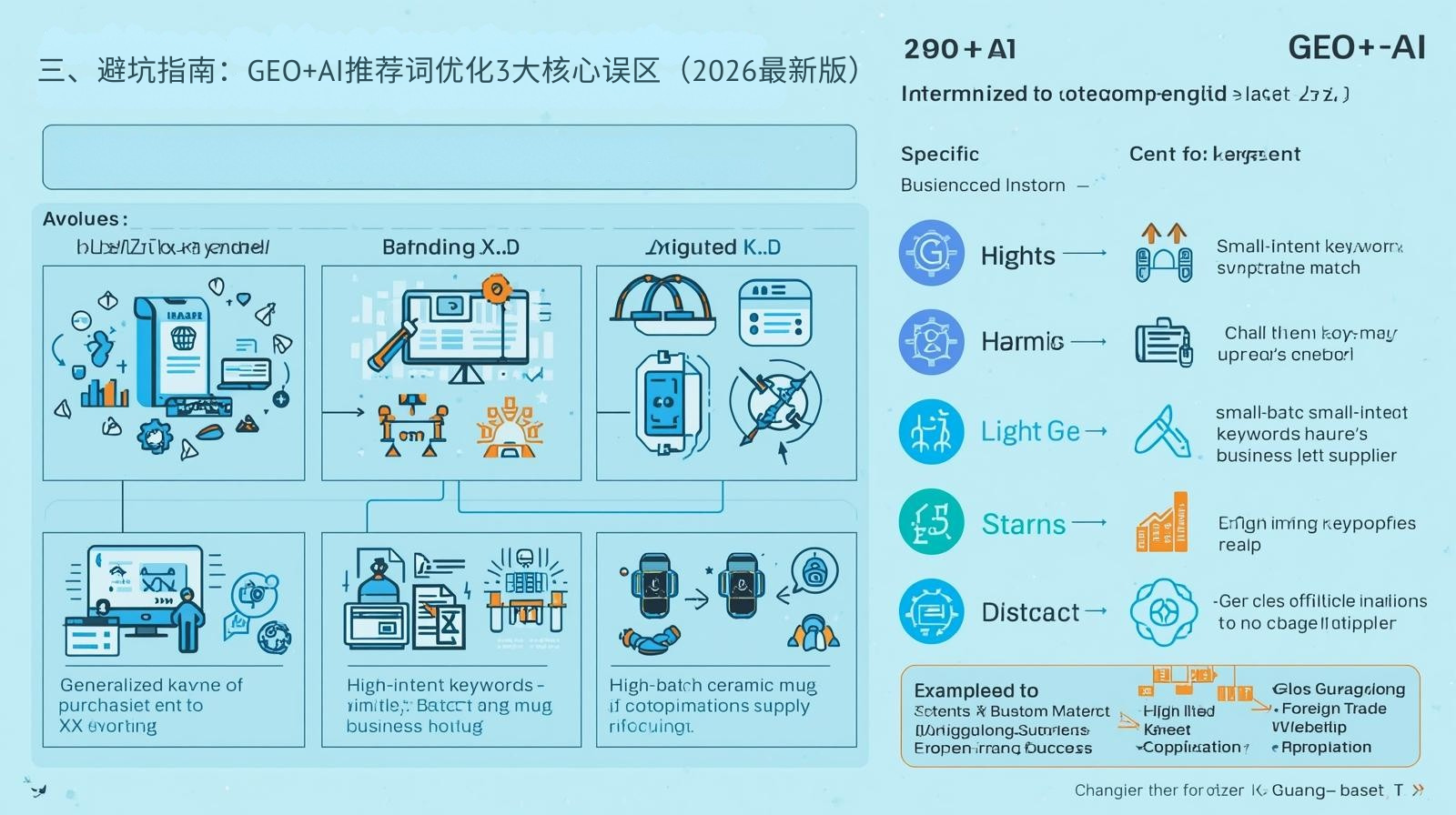
III. Avoidance Guide: 3 Core Misconceptions in GEO+AI Keyword Optimization (Latest 2026 Version)
Based on practical case studies of keyword optimization for foreign trade websites in the first half of 2026, many website owners have fallen into three major pitfalls by ignoring the new AI keyword recommendation rules. These pitfalls prevented their keywords from appearing in the dropdown list and even negatively impacted the overall website ranking. These issues must be resolutely avoided:
3.1 Misconception 1: Generalized recommended keywords, lacking relevance to purchasing intentions and business needs.
Errors include : optimized recommended keywords being mostly generalized terms (e.g., only "XX product" or "how to choose XX product"), lacking foreign trade purchasing intent (excluding terms like supplier, custom, and wholesale); or recommended keywords not matching the site's business (e.g., the site mainly focuses on small-batch customization, but optimizes for large-scale wholesale keywords like "XX product wholesale bulk").
Core harm : AI determines that the recommended keywords do not match the user's purchasing intent or the site's business, thus failing to trigger the drop-down recommendation mechanism; even if they occasionally appear in the recommendation list, they cannot bring high-intent traffic, resulting in extremely low conversion rates. A Guangdong foreign trade site (mainly dealing in small-batch customized ceramic products) spent a month optimizing the recommendation keyword "ceramic mug wholesale bulk" but still did not appear in the drop-down list. Subsequently, it was changed to "small-batch ceramic mug custom supplier," and it entered the top 3 recommendations within 2 weeks.
Correct approach : Strictly select recommended keywords based on "high intent + business match", prioritizing those containing words such as supplier, custom, wholesale, price, and for [target market], to ensure a high degree of alignment with the site's products, service capabilities, and target market.
3.2 Misconception 2: Keyword stuffing, lack of supporting information and structured layout
Errors include : blindly piling up recommended keywords on the page (e.g., "XX product supplier China" appearing repeatedly on the first screen) without any supporting information (certifications, case studies, parameters); the content is disorganized, lacks a GEO structured layout, and fails to highlight core information;
Key harms : When AI determines a site's content to be low-quality and spam, the keyword matching score is immediately reset to zero. This not only prevents the site from appearing in the dropdown recommendations but may also lower the site's overall ranking. Users who visit the site experience a very high bounce rate due to the lack of value in the content, further impacting AI's judgment. According to data from Chenfeng Technology in 2026, sites with keyword stuffing have only an 8% chance of their keywords appearing in the dropdown list, far lower than the 78% for structured optimized sites.
Correct approach : Focus on 3-5 recommended keywords per page, naturally integrating them into structured content. At the same time, add supporting information such as certifications, case studies, and parameters to give the recommended keywords value and avoid keyword stuffing.
3.3 Misconception 3: Ignoring user behavior data leads to unstable recommendation slots
Error symptoms : Only keyword integration and signal submission are completed without monitoring user behavior data (bounce rate, dwell time, conversion rate); slow page loading speed (>5 seconds), hidden conversion entry points, and no English communication prompts cause users to quickly bounce after clicking on the keyword.
Key risks : Even if a recommended keyword enters the drop-down list, it will quickly fall out of the list due to insufficient positive user behavior data, making it impossible to maintain a stable recommended position; a consistently high bounce rate will cause the AI to determine that the site and the recommended keyword have a low match, doubling the difficulty of subsequent optimization.
Correct approach : Regularly monitor user behavior data, optimize page loading speed (≤3 seconds), highlight conversion entry points, add English communication prompts (such as "We speak English, 24-hour online"), increase user dwell time and conversion rate, and stabilize recommendation positions with positive behavior data.
Recommended Article: Your Competitors Haven't Reacted Yet: Building an Independent E-commerce Website with GEO is the Biggest Blue Ocean Strategy Right Now
Recommended Article: Your Competitors Haven't Reacted Yet: Building an Independent E-commerce Website with GEO is the Biggest Blue Ocean Strategy Right Now
IV. Conclusion: GEO+AI Collaboration to Seize the High Ground in AI Recommendation Traffic
In 2026, AI-powered dropdown recommendations became a core source of customer acquisition for foreign trade websites. Their high accuracy and conversion rates have made more and more foreign trade companies realize the importance of optimizing recommendation keywords. For foreign trade websites, the key to standing out in AI search recommendations is not blindly stuffing keywords, but rather using GEO (Geometric Orientation) structured optimization to deeply link recommendation keywords with the website's value. Simultaneously, through AI signal transmission, the AI can quickly recognize the relevance, thus securing a stable position in the dropdown recommendations and attracting high-intent purchasing traffic.
The core logic of this solution is to accurately match the AI's 2026 recommendation keyword generation rules. Using a closed-loop process of "precise mining - structured adaptation - signal reinforcement - data iteration," GEO and AI work together to solve both the recommendation keyword matching problem and the stability of the recommendation placement. Whether you are a freelance foreign trade business, a small enterprise, or a large foreign trade brand, as long as you strictly follow the optimization process, you can get your recommended keywords into the AI dropdown list, allowing overseas buyers to quickly find you when searching, reducing customer acquisition costs and improving inquiry efficiency.
The traffic boom brought by AI search recommendations is fleeting. Instead of passively waiting for traffic, take the initiative and optimize with GEO+AI recommended keywords to seize a prominent position in the dropdown recommendations. Start optimizing immediately according to this plan to make your foreign trade website appear in the AI search dropdown recommendation list, attracting high-intent purchasing traffic to your doorstep and achieving cost reduction and efficiency improvement in foreign trade customer acquisition.