By February 2026, overseas buyers' sourcing habits had completely changed. More and more B2B buyers were directly using AI tools like ChatGPT and Perplexity to search for suppliers, products, and solutions, rapidly diverting traffic from traditional search engines to generative AI. For independent e-commerce websites, understanding and mastering GEO (Generative Engine Optimization) is crucial to being found by customers in this wave. Many people treat GEO as a new concept or mystical art, but it's actually a clear, practical, and standardized operational system that allows AI to proactively recommend your brand.

I. What exactly is GEO: An "identity card" for independent websites in the AI era?
GEO (Generative Engine Optimization) is a content and structure optimization system for generative AI such as ChatGPT, Gemini, and Perplexity. Its goal is to ensure that your independent website is crawled, understood, trusted, and prioritized for recommendation by AI crawlers to overseas buyers who ask questions.
Simply put: Traditional SEO improves your Google ranking, while GEO gets you directly featured in AI's answers .
According to OpenAI's official documentation, ChatGPT's online answers come from real-time scraping and aggregation of public web pages. The tool responsible for scraping is GPTBot , which reads website content according to rules, judges its authority and usefulness, and then organizes high-quality information into answers presented to users (https://platform.openai.com/docs/guides/gptbot ). GEO makes your independent website an authoritative source that GPTBot is willing to read, trust, and cite.
GEO's core value is very clear:
- Ensure that content from independent websites is reliably crawled by AI, without being blocked or misjudged.
- Let AI accurately understand your products, services, qualifications, production capacity, and customization capabilities.
- Let AI prioritize your information when answering buyers' questions.
- Transform AI search traffic into targeted, reachable, and convertible inquiries.
II. GEO is not SEO: Three key differences you must understand
Many foreign trade companies directly apply SEO practices to GEO, with completely ineffective results. By 2026, AI search logic will be completely different from traditional search engines, and the differences directly determine customer acquisition effectiveness. https://www.semrush.com/blog/ai-seo-vs-traditional-seo/
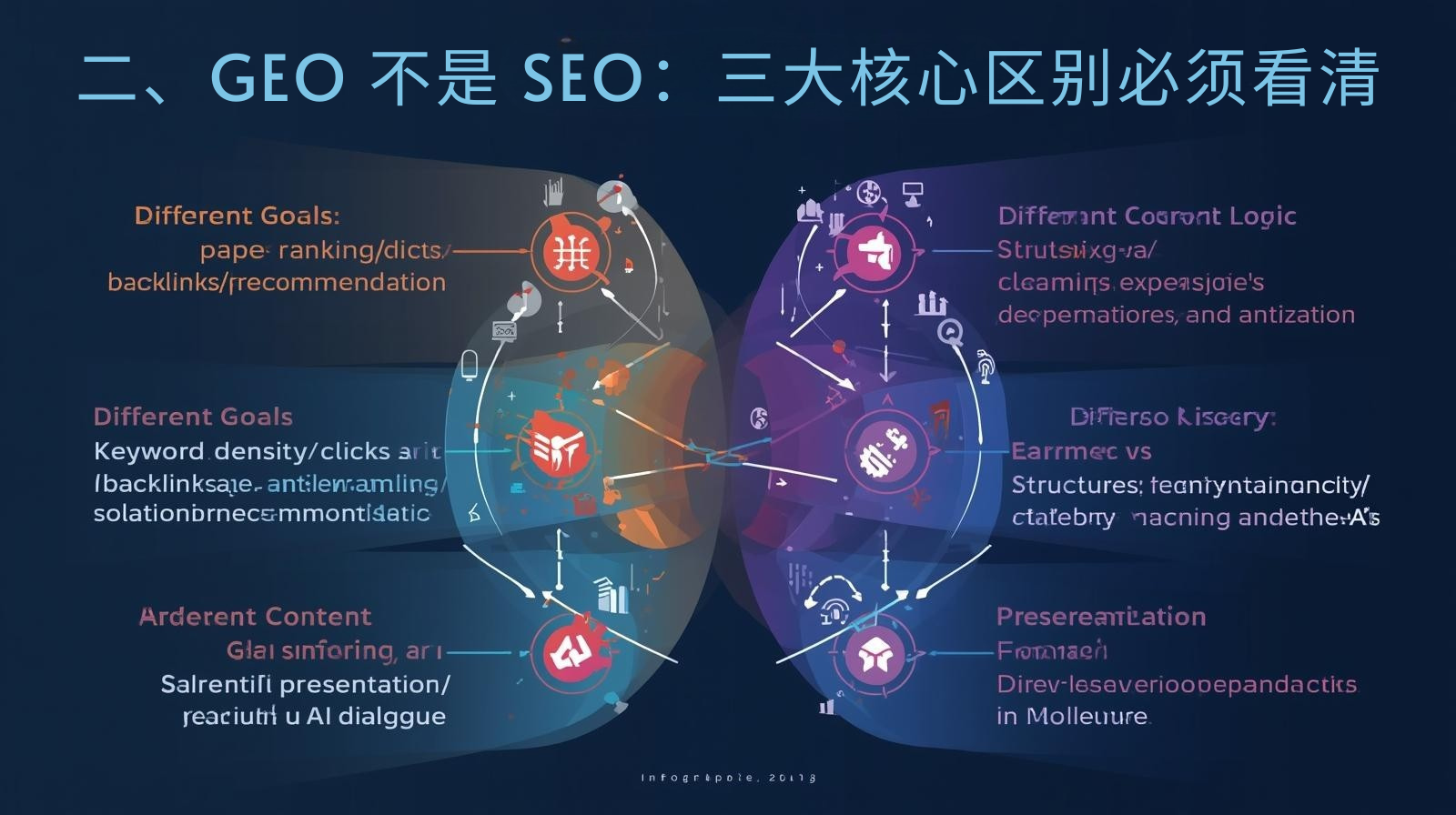
2.1 Different Goals
- SEO: The pursuit of page ranking and clicks in search results.
- GEO: Pursuing content that is understood, cited, and recommended by AI.
2.2 Different Content Logic
- SEO: Focusing on keyword density, number of backlinks, and page authority.
- GEO focuses on structure, authority, authenticity, and question-answer matching , while AI places greater emphasis on EEAT (experience, expertise, authority, and credibility).
2.3 Different presentation formats
- SEO: Users see a list of links and need to actively click to enter the website.
- GEO: Users can directly see your brand, solutions, and advantages in AI-powered conversations, establishing initial trust without needing to navigate to other devices.
III. How to Implement GEO: Practical Methods for Getting Independent Websites Featured in AI Recommendations
GEO isn't some kind of technical mystery, nor does it require complex code. Simply follow the steps to make your independent website "AI-friendly," and you can significantly increase your chances of being recommended. Below are the latest, actionable methods as of February 2026.
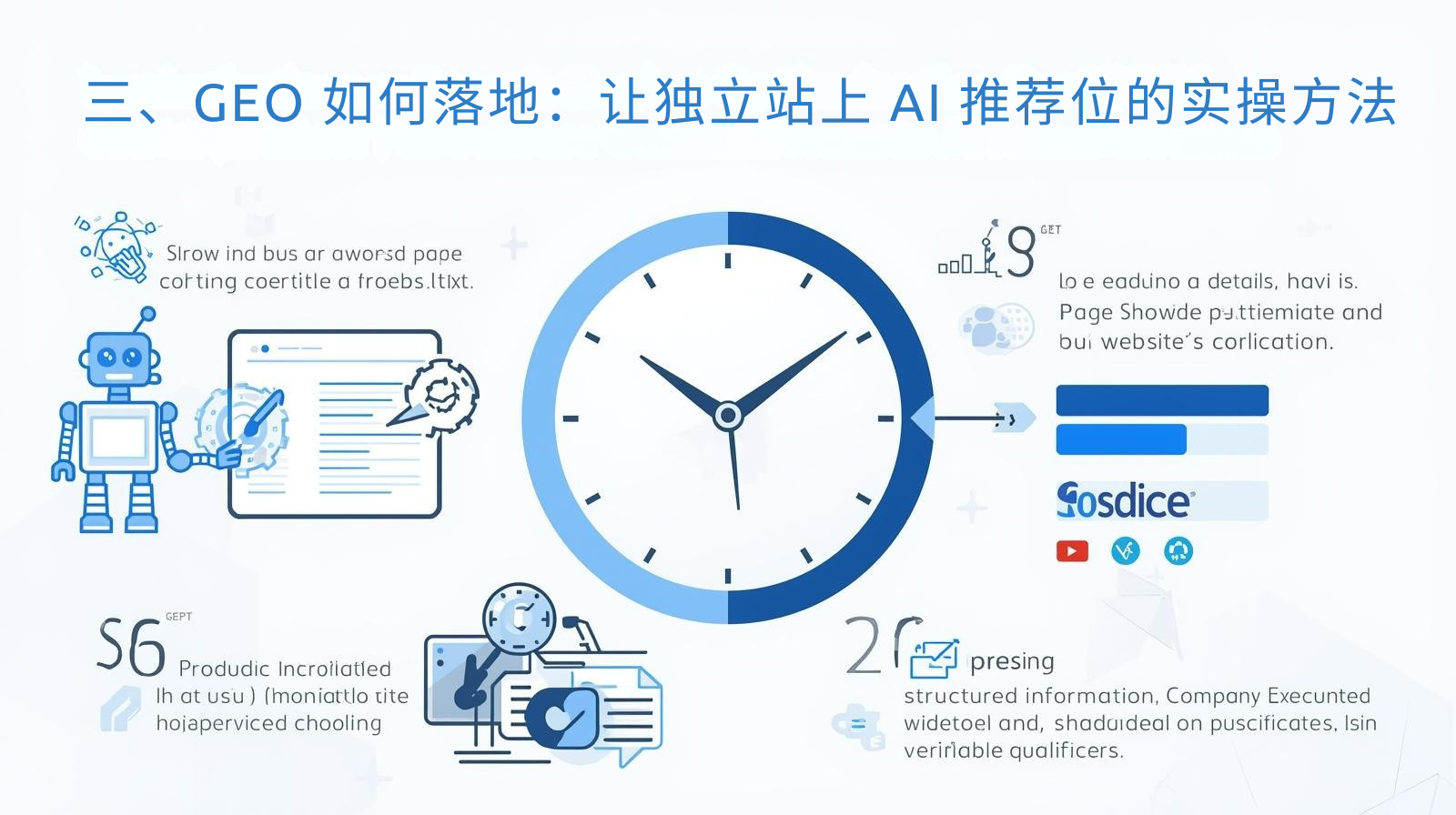
3.1 Grant AI crawling permissions to allow GPTBot to access the site successfully.
AI needs to be able to crawl your site before it can recommend anything to you.
- Allow GPTBot to crawl all core pages of the site in your website's robots.txt rules; do not block the AI crawler. (https://help.openai.com/en/articles/5097620-blocking-gptbot )
- To ensure fast page loading speeds, aim for a loading time of under 2 seconds in overseas target markets. This can be monitored and optimized using Google PageSpeed Insights (https://pagespeed.web.dev/).
- Reduce forced logins, excessive pop-ups, and complex verifications to prevent AI crawlers from being unable to read content.
3.2 Structured information presentation allows AI to understand you at a glance.
Unlike humans, AI doesn't read entire articles; it prefers clear, well-organized, and extractable knowledge points (https://schema.org/docs/gs.html ).
- Standardized product information: Model number, material, parameters, MOQ, delivery date, and certifications are presented using fixed modules.
- Clear company information: establishment date, size, factory, certificates, service capabilities, all in a standardized format.
- Frequently Asked Questions (FAQ) Pre-emptive: Compile the most frequently asked questions from overseas buyers into a FAQ and provide clear answers directly.
- Verifiable Qualifications: CE, FDA, ISO, and other certificates are provided with official verification links to enhance credibility : https://ec.europa.eu/growth/tools-databases/nando/
3.3 Strengthen authoritative and trust signals to make AI willing to recommend you.
One of the core criteria for AI recommendations in 2026 is verifiable authority ; the more authentic and verifiable the content, the more likely it is to be selected (https://developers.google.com/search/blog/2024/05/google-search-eeat-guidance ).
- Showcases real client cases, partner brands, and factory photos.
- Contact information, address, and social media accounts (LinkedIn, etc.) should be complete and consistent.
- Keep content up-to-date; outdated information will reduce the trust level of AI.
Recommended Article: Your Competitors Haven't Reacted Yet: Building an Independent E-commerce Website with GEO is the Biggest Blue Ocean Strategy Right Now
IV. Why do GEO? A must-have for independent e-commerce websites in 2026
By February 2026, over 40% of global B2B purchasing decisions will be influenced by AI search recommendations. Not becoming a GEO (Global External Marketing Provider) means giving up a natural traffic entry point in the AI era. (https://www.mckinsey.com/capabilities/growth-marketing-and-sales/our-insights/mckinsey-global-survey-of-b2b-buyers )
GEO brings not just short-term traffic, but long-term, low-cost, and highly accurate AI customer acquisition capabilities:
- More precise targeting: AI recommends buyers with specific needs.
- Lower cost: Once included by AI, it can continuously obtain free exposure.
- Higher barriers to entry: Once content and authority are accumulated, competitors find it difficult to quickly replicate.
- Adapting to the Future: AI Search Will Only Become More Widespread; GEO is a Long-Term Infrastructure
Make good use of GEO and let AI proactively find customers for you.
AI is redefining customer acquisition in foreign trade. In 2026, competition will no longer be about platform competition or advertising bidding, but about who can be trusted and recommended by AI. GEO (Geometric Optimization) is not a distant technological concept, but a fundamental capability that every independent foreign trade website should immediately build. By making your website correct, clear, and authoritative, AI will become your 24/7 global customer acquisition assistant.
To accelerate the implementation of GEO results, the underlying architecture of your independent website is crucial. PinDian Technology boasts over a decade of experience in building websites for international trade, serving more than 7,000 clients. Built with React technology, our websites offer a smoother browsing experience, faster loading times overseas, and a structure naturally adapted for AI crawling and GEO optimization. From the ground up, we support structured information presentation, GPTBot-friendly access, and authoritative trust display, giving your independent website an AI recommendation advantage from launch and allowing you to easily seize the new AI-driven customer acquisition opportunities in international trade in 2026.