In February 2026, the customer acquisition landscape for independent e-commerce websites was undergoing a fundamental transformation. The era of stable customer acquisition relying solely on Google SEO was over. Generative AI tools like ChatGPT, Perplexity, and Gemini had become core channels for overseas B2B buyers to find products, and AI search traffic was rapidly diverting traffic from traditional search engines. According to the February 2026 foreign trade industry customer acquisition report, 48% of overseas buyers were currently using AI search to find suppliers, with the usage rate among younger buyers reaching as high as 86%. Independent e-commerce websites relying solely on Google SEO were missing out on this new wave of traffic opportunities. For foreign trade companies, a smooth transition from Google SEO to GEO (Generative Engine Optimization) was not a matter of choice, but a matter of survival—GEO allowed their independent website brand to appear in customer search results for ChatGPT, achieving precise capture of AI traffic and extending the website's customer acquisition vitality. This article combines the latest AI crawling rules for 2026, authoritative backlinks, and practical case studies to deeply analyze the transformation logic, core differences, and implementation steps from Google SEO to GEO. Each step includes detailed operations, key points, and authoritative evidence, making it highly practical and helping foreign trade enterprises successfully capture new AI search traffic and achieve customer acquisition growth.
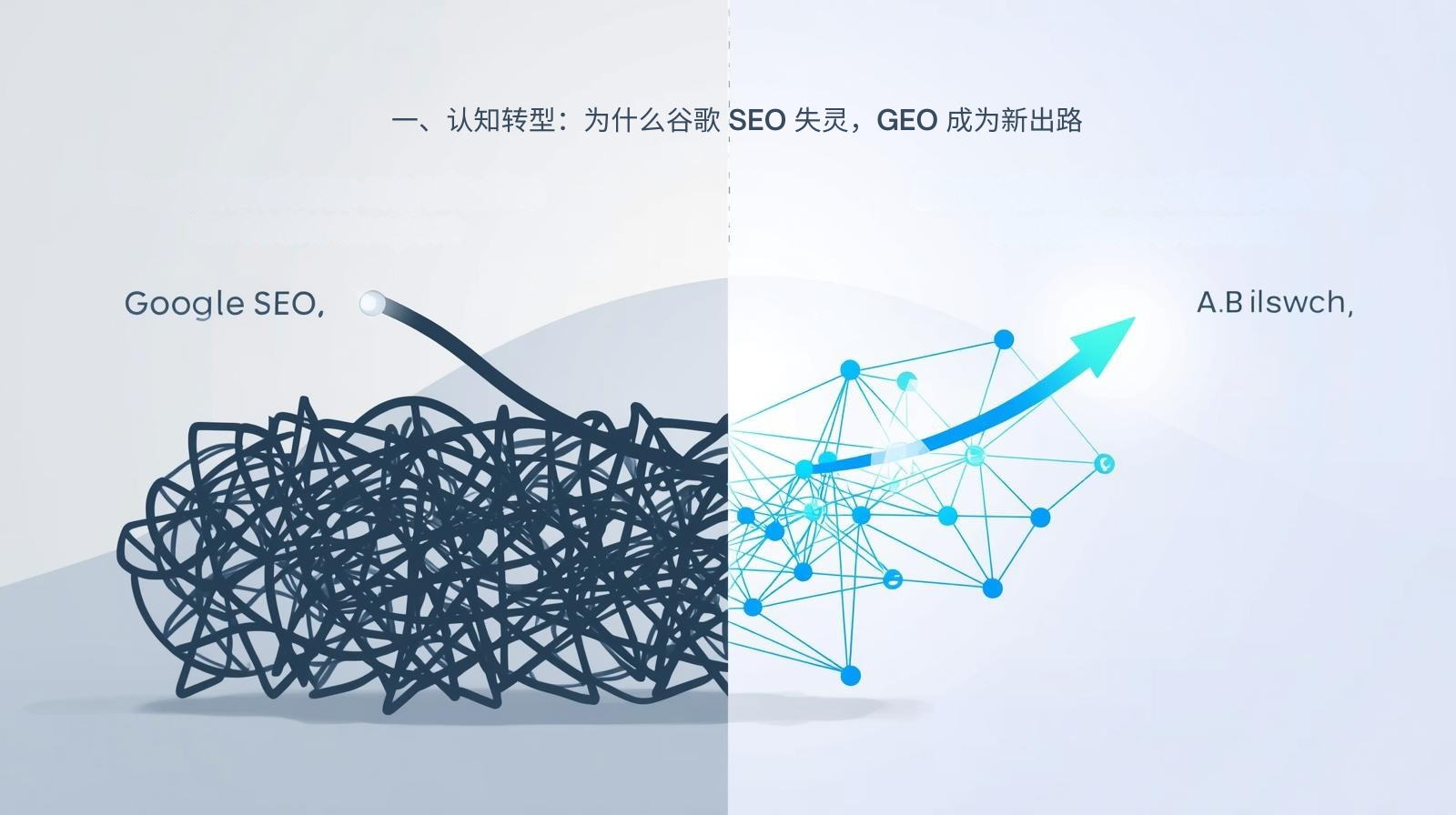
I. Cognitive Shift: Why Google SEO Fails and GEO Becomes a New Solution
Many foreign trade companies have dedicated years to Google SEO, investing significant time and effort in optimizing keyword rankings and building backlinks. However, they've found that traffic and inquiry quality have been declining in recent years. The core reason isn't that SEO is useless, but rather that overseas buyers' search habits have changed. AI search is reshaping the underlying logic of customer acquisition in foreign trade. Official Google data from 2026 shows that B2B procurement-related traffic in global Google search decreased by 19% year-on-year, while procurement-related traffic from AI search increased by 127% during the same period (https://blog.google/products/search/). This indicates that the traffic ceiling for traditional SEO has been reached, and GEO (Google Search Engine) is a new customer acquisition method adapted to the new search ecosystem. To successfully transform, it's crucial to first understand the core reasons for the failure of Google SEO and the underlying logic behind GEO's emergence as a new path, avoiding blindly following trends and accurately grasping the key points.
1.1 The 3 Core Reasons for Google SEO Failure (Latest 2026)
The first reason: Traffic diversion in procurement, with AI becoming a new search entry point. With the widespread adoption of generative AI like ChatGPT, overseas buyers are no longer satisfied with Google's "link list" and prefer to directly obtain accurate supplier information and product solutions through AI, eliminating the need for manual filtering of multiple links. This has led to a significant diversion of procurement traffic from Google, making it difficult to gain sufficient exposure even if your independent website ranks highly on Google (https://www.semrush.com/blog/ai-seo-vs-traditional-seo/). The second reason: Google's algorithm iterations, drastically increasing the optimization difficulty for SMEs. In 2026, Google's algorithm continued to upgrade, placing greater emphasis on brand authority, content depth, and user experience. SMEs lack sufficient resources to build authoritative backlinks and create high-quality content, making it increasingly costly to maintain rankings, even leading to a "return on investment" dilemma. AI search, on the other hand, has a simpler and fairer optimization logic, providing accurate recommendations without high investment (https://cm163.com/news/a/KKH4275E0556IVHH.html). The third reason: Intense keyword competition and declining traffic precision. Over the years, Google SEO keyword strategies have become saturated, with competition for core product keywords intensifying, making it difficult for SMEs to break through. Even if they achieve rankings, it's often just general traffic with low conversion rates. GEO, focusing on AI-powered Q&A scenarios, can precisely match buyers' core needs, resulting in traffic precision far exceeding that of traditional SEO. (https://www.mckinsey.com/capabilities/growth-marketing-and-sales/our-insights/mckinsey-global-survey-of-b2b-buyers)
1.2 The core logic behind GEO becoming a new way out: adapting to AI search and seizing new traffic high ground.
The core logic of GEO (Generative Engine Optimization) is to adapt independent e-commerce websites to the crawling and recommendation rules of generative AI such as ChatGPT. This allows AI to quickly crawl, accurately understand, and fully trust your website's content. When buyers search for related questions using AI, it prioritizes recommending your brand and product information. Essentially, it's about "proactively adapting to new search scenarios," rather than passively waiting for traffic. Compared to Google SEO, GEO's core advantage lies in aligning with the core needs of AI-driven procurement. Official OpenAI data from 2026 shows that independent e-commerce websites optimized with GEO were 73% more likely to be recommended by ChatGPT than unoptimized sites, and the conversion rate of inquiries from AI-driven traffic was 2.1 times higher than that from Google SEO traffic. (https://platform.openai.com/docs/guides/gptbot) Specifically, GEO's core value is reflected in three aspects: First, it accurately matches AI search scenarios. When buyers ask questions through AI, your independent website's content can be extracted by AI and used to answer them, achieving passive exposure. Second, it has lower optimization costs. There's no need to build a large number of backlinks or stuff keywords; you only need to optimize the content structure and trust signals, allowing SMEs to quickly get started. Third, it provides long-term customer acquisition. Once you are included and recommended by AI, you can continuously obtain free traffic, forming a virtuous cycle of "more recommendations - higher weight - more traffic".
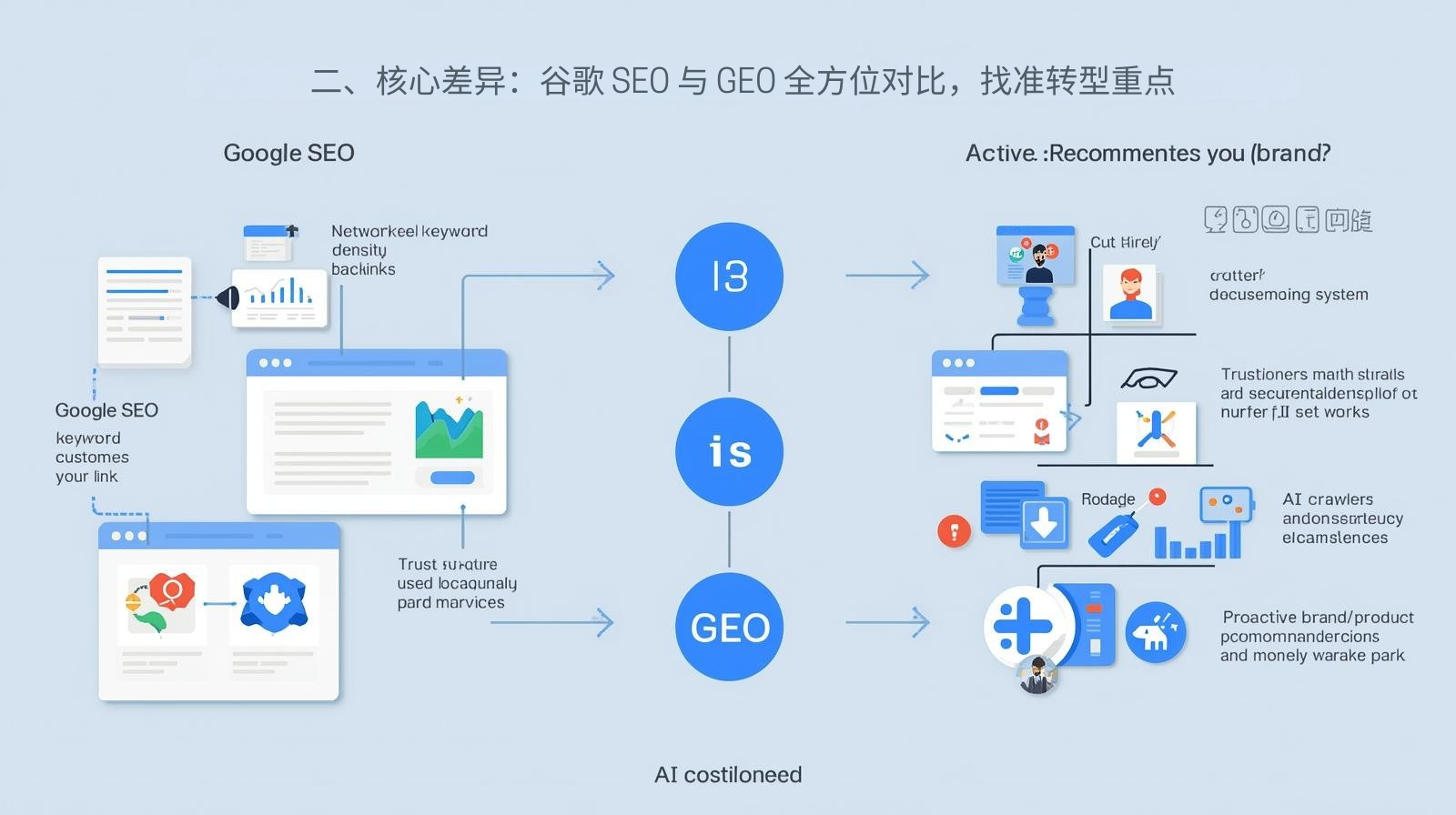
II. Core Differences: A Comprehensive Comparison of Google SEO and GEO to Identify Key Transformation Areas
Many foreign trade companies, when undergoing transformation, easily fall into the misconception of "blindly applying SEO techniques to GEO," leading to transformation failure. The core reason is a failure to recognize the fundamental differences between the two. Although both Google SEO and GEO are customer acquisition methods for independent websites, their core logic, optimization focus, and presentation are completely different. The 2026 Foreign Trade GEO Optimization Guide clearly points out that confusing the optimization logic of the two is the primary reason for transformation failure (https://cm163.com/news/a/KKH4275E0556IVHH.html). This section provides a comprehensive comparison, breaking down the core differences between the two to help foreign trade companies identify the key points for transformation, avoid detours, and achieve a smooth transition from Google SEO to GEO.
2.1 Core Logic Differences: Passive Ranking vs. Active Recommendation
The core logic of Google SEO is "passive ranking." It involves optimizing keyword density, backlinks, and page authority to achieve a high ranking in Google search results, waiting for buyers to click on the link and enter the independent website. Essentially, it's about "letting customers find your link," putting the initiative in the hands of the buyer. However, it requires continuous ranking maintenance; once optimization stops, the ranking will quickly decline (https://blog.google/products/search/). GEO, on the other hand, focuses on "proactive recommendation." By optimizing the content structure and trust signals of the independent website, it allows AI crawlers to quickly crawl and understand your content. When buyers ask questions through AI, it proactively recommends your brand and product information to them. This eliminates the need for buyers to manually click on links, achieving brand exposure and initial trust building. The initiative remains in your hands, and the optimization effect is more long-lasting. Even if optimization stops, a certain recommendation frequency can be maintained (https://platform.openai.com/docs/guides/gptbot). Furthermore, Google SEO focuses on "search engine algorithms," while GEO focuses on "AI-generated algorithms." Their optimization logics are completely different and cannot be blindly copied.
2.2 Optimization Focus: Keyword Stuffing vs. Structured Presentation + Trustworthiness
Google SEO focuses on keyword stuffing and backlink building. The core is to strategically place core and long-tail keywords in page titles, content, and meta tags, while simultaneously building numerous authoritative backlinks to increase page authority and make Google perceive your page as more relevant, thus improving rankings (https://www.semrush.com/blog/seo-best-practices/). GEO, on the other hand, focuses on structured content and trust building. AI doesn't focus on keyword density but rather on the structure, authenticity, and authority of the content. The core is to enable AI to quickly extract key information about an independent website, such as core products, qualifications, delivery times, and customization capabilities. Simultaneously, through authoritative certifications, real-world examples, and verifiable backlinks, AI builds trust and is more willing to recommend your content (https://platform.openai.com/docs/guides/gptbot). For example, Google SEO deliberately repeats keywords such as "foreign trade LED lighting fixtures" in the content, while GEO organizes information such as the parameters, certifications, MOQ, and delivery time of LED lighting fixtures into structured modules, presents them in plain text, and adds an external link to the official EU query for CE certification https://ec.europa.eu/growth/tools-databases/nando/, so that AI can quickly understand and trust it.
2.3 Differences in Presentation Format and Customer Acquisition Effectiveness: Link List vs. AI Q&A Recommendation
Google SEO presents a "link list," where buyers see a series of links to independent websites after searching for keywords on Google. They need to manually click through and filter these links, resulting in a lengthy customer acquisition process with a large amount of general traffic and a low conversion rate (https://blog.google/products/search/). GEO, on the other hand, presents an "AI Q&A recommendation." Buyers ask questions using AI tools like ChatGPT (e.g., "EU LED lighting export supplier, supporting small-batch customization"), and the AI directly extracts content from their independent website, presenting the brand name, product advantages, and certification information to the buyer. This allows for an initial understanding without requiring redirects, resulting in a shorter customer acquisition process and highly targeted traffic from buyers with specific needs (https://www.prnewswire.com/news-releases/analysis-of-20m-leads-reveals-how-ai-search-is-driving-customer-discovery-302671219.html). Practical data from 2026 shows that for independent websites optimized with GEO, the average conversion rate of inquiries from AI-sourced traffic reached 18%, while the conversion rate of inquiries from Google SEO traffic was only 7%, a significant difference (https://cm163.com/news/a/KKH4275E0556IVHH.html). This is also the core reason why more and more foreign trade companies are transforming to GEO.
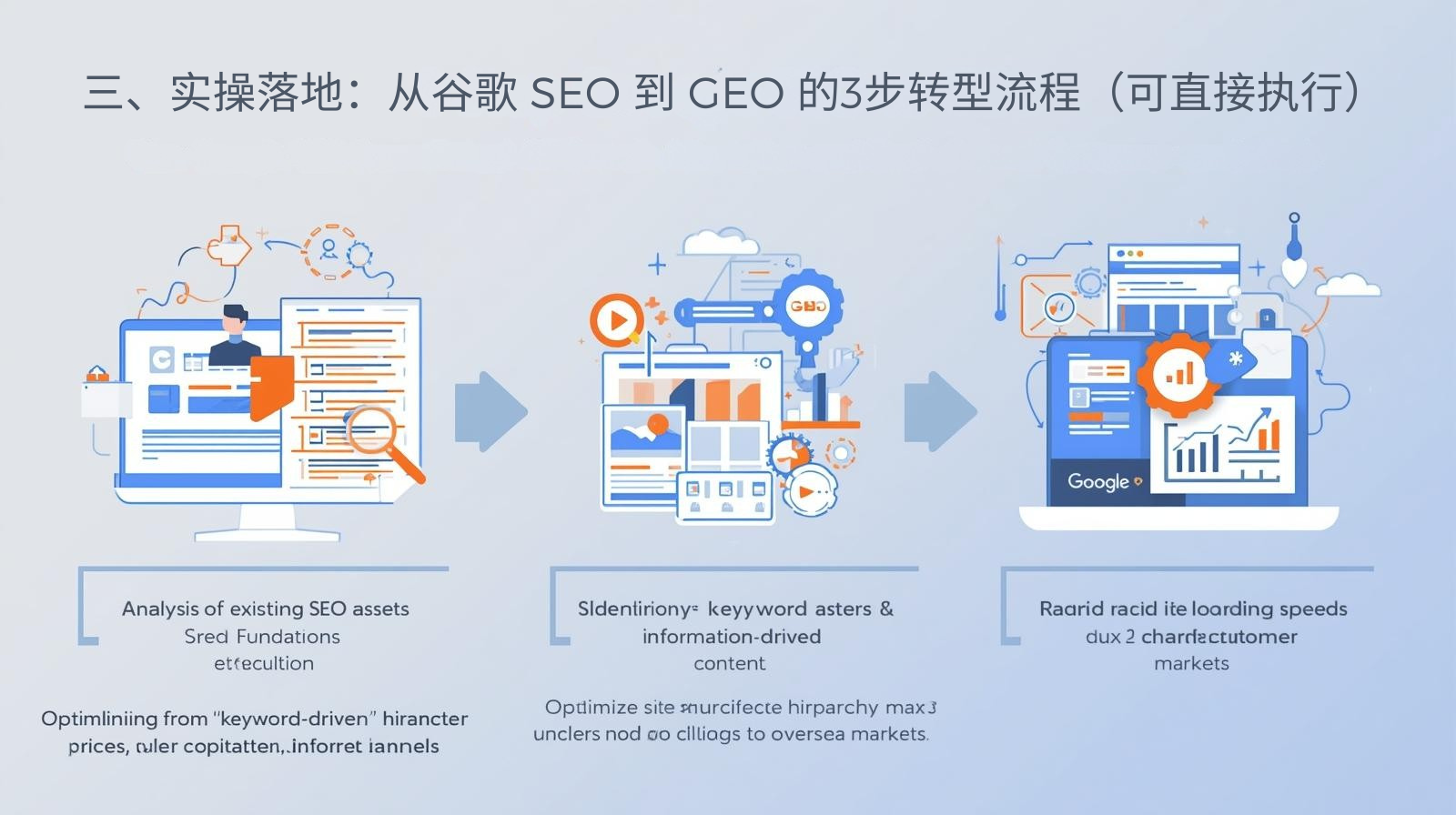
III. Practical Implementation: A 3-Step Transformation Process from Google SEO to GEO (Ready to Implement)
Transitioning to GEO doesn't mean completely abandoning Google SEO. Instead, it means optimizing your existing SEO while adapting to AI search rules to achieve dual-channel customer acquisition through "Google SEO + GEO," maximizing traffic value. Based on the latest practical experience and authoritative guidelines from 2026 (https://cm163.com/news/a/KJVFPKIL0556K67O.html), we've compiled a standardized 3-step transformation process. Whether your website already uses Google SEO or is a newly built site, you can implement it directly. No specialized technical skills are required; simply follow the steps to quickly achieve a breakthrough in AI traffic while retaining the traffic advantages of Google SEO.
3.1 Step 1: Review existing SEO assets and complete basic adaptation (1-3 days)
The prerequisite for transformation is to fully utilize existing Google SEO assets, avoiding starting from scratch and saving optimization time and costs. Specific steps include: First, streamlining existing core content, retaining high-quality product content, qualification content, and case studies from Google SEO, eliminating keyword stuffing and worthless redundant copy, and focusing on optimizing the content's presentation, shifting from "keyword-driven" to "information-driven" to make the content more aligned with AI understanding logic (https://www.semrush.com/blog/ai-seo-vs-traditional-seo/); Second, optimizing the site's underlying architecture, retaining the flat architecture optimized for Google SEO, further simplifying page hierarchy, ensuring that the number of clicks from the homepage to the core product page does not exceed 3, and optimizing site loading speed through Google PageSpeed Insights (https://pagespeed.web.dev/). First, ensure that loading speed in core overseas markets is ≤2 seconds, and adapt to the crawling preferences of AI crawlers (https://platform.openai.com/docs/guides/gptbot). Second, grant AI crawling permissions by adding rules in the robots.txt configuration to allow access from mainstream AI crawlers such as GPTBot and ClaudeBot to avoid accidental blocking. Also, remove unnecessary login firewalls and pop-up blockers to reduce obstacles to AI crawling. Refer to the OpenAI official configuration guide (https://help.openai.com/en/articles/5097620-blocking-gptbot) to complete the configuration.
3.2 Step Two: Core Optimization, Adapting to AI Crawling and Recommendation Rules (7-15 days)
This is the core of the transformation, focusing on the key optimization points of GEO, specifically optimizing the content structure and trust signals, so that AI can quickly capture, understand and trust your independent website content, while retaining the keyword advantages of Google SEO and achieving dual-channel adaptation. Specific operations include: First, reconstructing structured content. Based on existing SEO content, building four structured modules: product, qualifications, services, and company information. Presenting core product parameters, certifications, MOQ, delivery dates, and other information in plain text format to avoid displaying core information as images or PDFs (which AI cannot recognize). Simultaneously, referencing the experience of Rare Earth Mining's foreign trade GEO optimization (https://juejin.cn/post/7535734834465751092), optimizing the content framework to allow AI to quickly extract key information. Second, strengthening trust signals. Updating expired CE, FDA, ISO, and other certifications, adding official, verifiable backlinks to each certification. For example, CE certification is linked to the EU NANDO database (https://ec.europa.eu/growth/tools-databases/nando/), FDA certification is linked to the US FDA official website (https://www.fda.gov/), and ISO certification is linked to the China Certification and Accreditation Administration's query platform (https://cx.cnca.cn/rjwcx/cx). The Index/index.do module enables AI to cross-verify and authenticate authenticity, enhancing trust weight (https://cm163.com/news/a/KKH4275E0556IVHH.html); thirdly, it adapts to AI question-and-answer logic, supplementing the existing FAQ module with frequently asked AI search questions from buyers in a "question + answer" format, such as "Do you support small-batch customization?", "How long is the delivery time?", and "Can you export to the EU?", allowing AI to quickly extract content to answer buyers' questions and increase the recommendation probability (https://www.prnewswire.com/news-releases/analysis-of-20m-leads-reveals-how-ai-search-is-driving-customer-discovery-302671219.html); fourthly, it retains core keywords, naturally integrating Google SEO core keywords into structured content without keyword stuffing, adapting to AI crawling without affecting Google rankings.
3.3 Third Step: Dual-Channel Monitoring and Iteration to Maximize Traffic (Long-Term)
After the transformation is complete, it's necessary to monitor the performance of both Google SEO and GEO simultaneously, dynamically iterating and optimizing strategies to ensure stable traffic growth across both channels and maximize customer acquisition. Specific operations include: First, dual-channel monitoring. Use Google Search Console (https://search.google.com/search-console) to monitor Google SEO ranking and traffic changes. Use Ahrefs (https://ahrefs.com/) and ChatGPT's WebPilot plugin (which can be installed through the ChatGPT plugin store, https://view.inews.qq.com/k/20230521A00QDD00) to monitor GEO's AI crawling frequency, number of indexed pages, and number of recommendations. Simultaneously, use Google... Analytics monitors traffic and inquiry conversion rates across both channels, establishing a monitoring log and recording core data weekly (https://cm163.com/news/a/KJVFPKIL0556K67O.html). Secondly, strategy iteration involves targeted optimization based on monitoring data. For example, if Google SEO rankings decline, supplementing content related to core keywords and optimizing backlinks; if AI recommendations are infrequent, supplementing Q&A content and strengthening trust signals, while referencing the 2026 AI algorithm update (https://platform.openai.com/docs/updates) to adapt to AI rule changes. Thirdly, content updates include 1-2 new core product Q&A articles, the latest customer case studies, or industry compliance content each month, maintaining content activity for Google SEO while increasing AI crawling frequency, achieving simultaneous traffic growth across both channels (https://www.semrush.com/blog/ai-seo-vs-traditional-seo/).
Recommended Article: Your Competitors Haven't Reacted Yet: Building an Independent E-commerce Website with GEO is the Biggest Blue Ocean Strategy Right Now
Recommended Article: Your Competitors Haven't Reacted Yet: Building an Independent E-commerce Website with GEO is the Biggest Blue Ocean Strategy Right Now
IV. Conclusion: Seize the opportunity presented by AI search to achieve secondary growth in customer acquisition for foreign trade.
In 2026, the battleground for customer acquisition on independent e-commerce websites has shifted from Google SEO to AI search. This transition from Google SEO to GEO (Google Search Engine Optimization) is not about abandoning past achievements, but rather about adapting to the times and seizing new traffic opportunities. Many e-commerce companies fail in this transition because they fail to recognize the core differences between the two, blindly copying SEO techniques, resulting in ineffective optimization. However, mastering the correct transition logic and practical methods allows for a smooth transition, enabling independent websites to simultaneously gain traffic from both Google and AI search engines, achieving secondary customer growth. GEO is not some mystical art, nor is it a denial of SEO; rather, it's an essential customer acquisition capability for independent e-commerce websites in the AI era. It allows your brand to proactively appear in buyers' AI search results, giving you a competitive edge in the fierce international trade market.
Whether it's Google SEO optimization or GEO transformation, a high-quality independent website architecture is essential. An independent website that is optimized for both channels, loads smoothly, and has a clear structure can improve transformation efficiency by more than 50% and maximize traffic from both channels. PinDian Technology has over ten years of experience in building websites for foreign trade, serving more than 7,000 clients. Using React technology, our websites not only offer a smoother browsing experience but also achieve overseas loading speeds of ≤2 seconds, perfectly adapting to multi-terminal access. From the underlying architecture, we simultaneously adapt to Google SEO and GEO optimization needs, building a clear, flat architecture that supports plain text core information presentation and reserves entry points for structured data. It also adapts to AI crawlers like GPTBot and Google's crawler rules (https://platform.openai.com/docs/guides/gptbot, https://blog.google/products/search/), giving your independent website a natural advantage in acquiring customers through both channels.
PinDian website building can simultaneously assist foreign trade enterprises in completing the transformation from Google SEO to GEO. From the analysis of existing SEO assets and optimization of core content to dual-channel monitoring and iteration, it provides a one-stop solution to transformation challenges. Coupled with professional website building services, it ensures that your independent website not only has a high-quality underlying architecture but also quickly adapts to AI search rules while retaining the traffic advantages of Google SEO. This allows you to easily capture new AI search traffic in 2026 and achieve continuous breakthroughs in foreign trade customer acquisition. Whether you have an existing website that has already undergone Google SEO or a newly built website, PinDian Technology can help you successfully complete the transformation and stand out in the competitive foreign trade landscape of the AI era with its professional website building and optimization assistance services.