By February 2026, overseas B2B procurement had fully shifted to AI-powered conversational search. Over 60% of professional buyers no longer relied on traditional Google page-flipping filtering, but instead directly asked questions like "reliable XX factory" or "customizable XX supplier" in tools such as ChatGPT, Google Gemini, and Perplexity. Factory websites prioritized by AI were capturing the highest quality, lowest-cost, and most accurate inquiries in the industry. GEO (Generative Engine Optimization) is not a marketing gimmick, but a practical system that allows your factory's independent website to be recognized, trusted, and proactively recommended to buyers by ChatGPT. This is the fundamental reason why a large number of foreign trade factories, from the Pearl River Delta to the Yangtze River Delta, have abandoned the fierce competition of pure platform competition and turned to independent website GEO optimization.
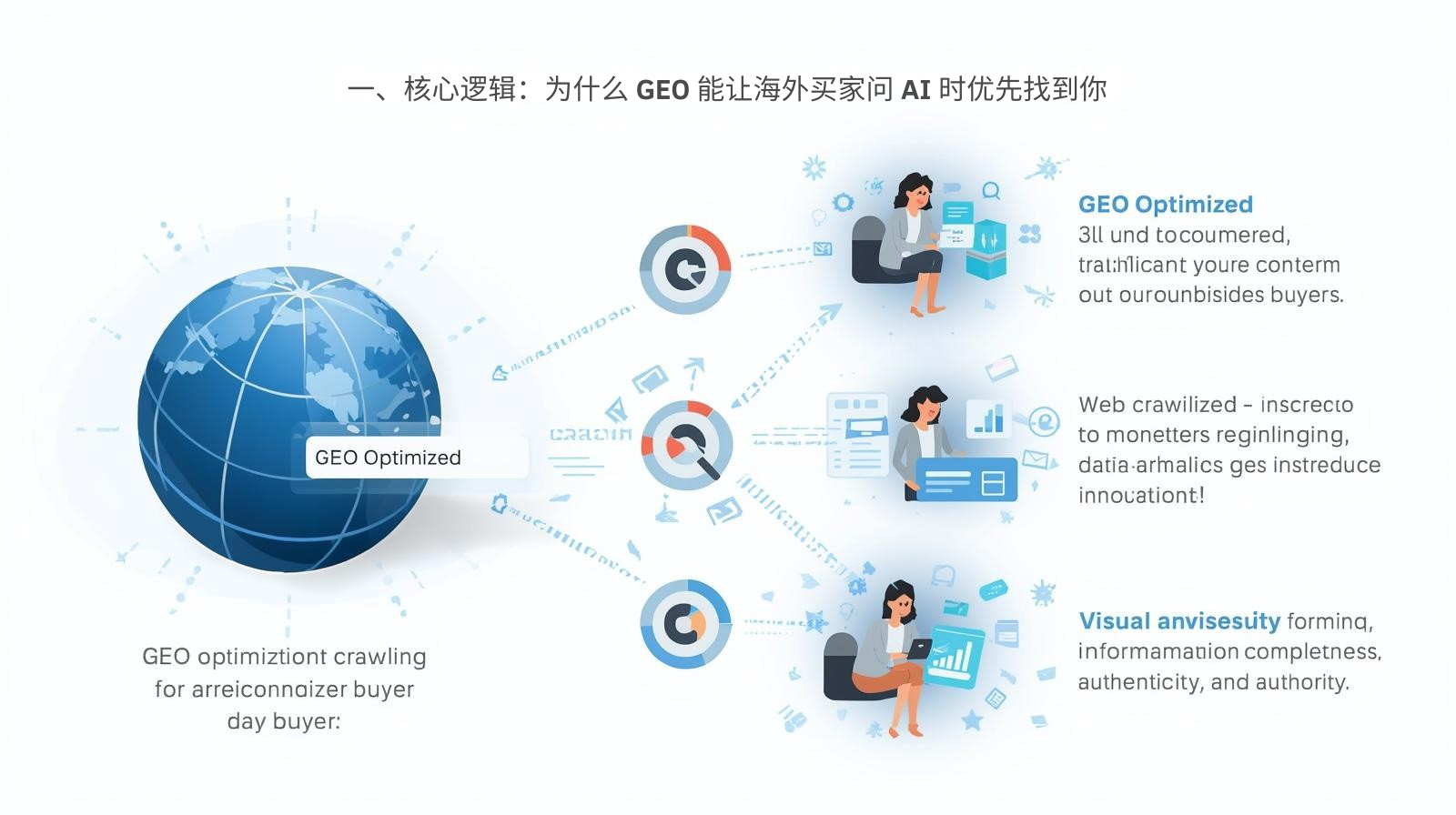
I. The Truth About the Trend: 3 Core Reasons Why Export-Oriented Factories Must Implement GEO (Geometric Operation)
1.1 AI is reshaping the procurement path; those who don't become GEOs will "disappear" from ChatGPT.
Overseas procurement decisions are shifting from "search—click—compare" to "AI providing direct answers." According to Semrush's B2B AI Search Report released in February 2026, ChatGPT's daily growth in manufacturing and industrial product-related queries exceeded 23%. Buyers are placing more trust in authoritative conclusions integrated by AI than in single advertising pages. Factory websites without GEO optimization, even if ranking on the first page of Google search results, are unlikely to appear in AI responses, effectively forfeiting the largest source of new traffic. OpenAI's official documentation clearly states that GPTBot prioritizes crawling content from enterprise websites with clear structure, authentic information, and verifiable authority. GEO helps your factory website conform to these crawling rules : https://platform.openai.com/docs/guides/gptbot .
1.2 Factory Advantages: Naturally Compatible with GEOs, Conversion Rate Far Exceeds that of Ordinary Trading Companies
Information such as the production capacity, certifications, delivery time, customization capabilities, actual workshop photos, and patent qualifications of foreign trade factories are strong signals for AI to determine "trustworthy suppliers." This type of information is more easily adopted by ChatGPT than vague claims from trading companies. Industry testing data from 2026 shows that for factory independent websites that have completed GEO optimization, AI-sourced inquiries can account for more than 35% of total inquiries, with higher customer accuracy, stronger bargaining power, and higher repurchase rates, because AI has already completed the first round of trust endorsement for you. https://www.leadscloud.com/waimao-b2b-bianju/
1.3 Customer acquisition costs continue to decline, and one-time optimization yields long-term benefits.
Traditional B2B platforms see annual fees, pay-per-click advertising, and trade show costs rise year after year. GEO, however, is a one-time deployment with long-term compounding returns. Once your factory information is incorporated into the trusted knowledge base by the AI model, you can reliably obtain AI-recommended traffic with almost no subsequent investment. Compared to paid advertising, GEO's AI-driven customer acquisition cost is on average 68% lower, making it ideal for manufacturing factories seeking stable, low-cost customer acquisition. (https://www.pinshop.cn/blog/foreign-trade-geo-ai-search-suggestion-optimization )
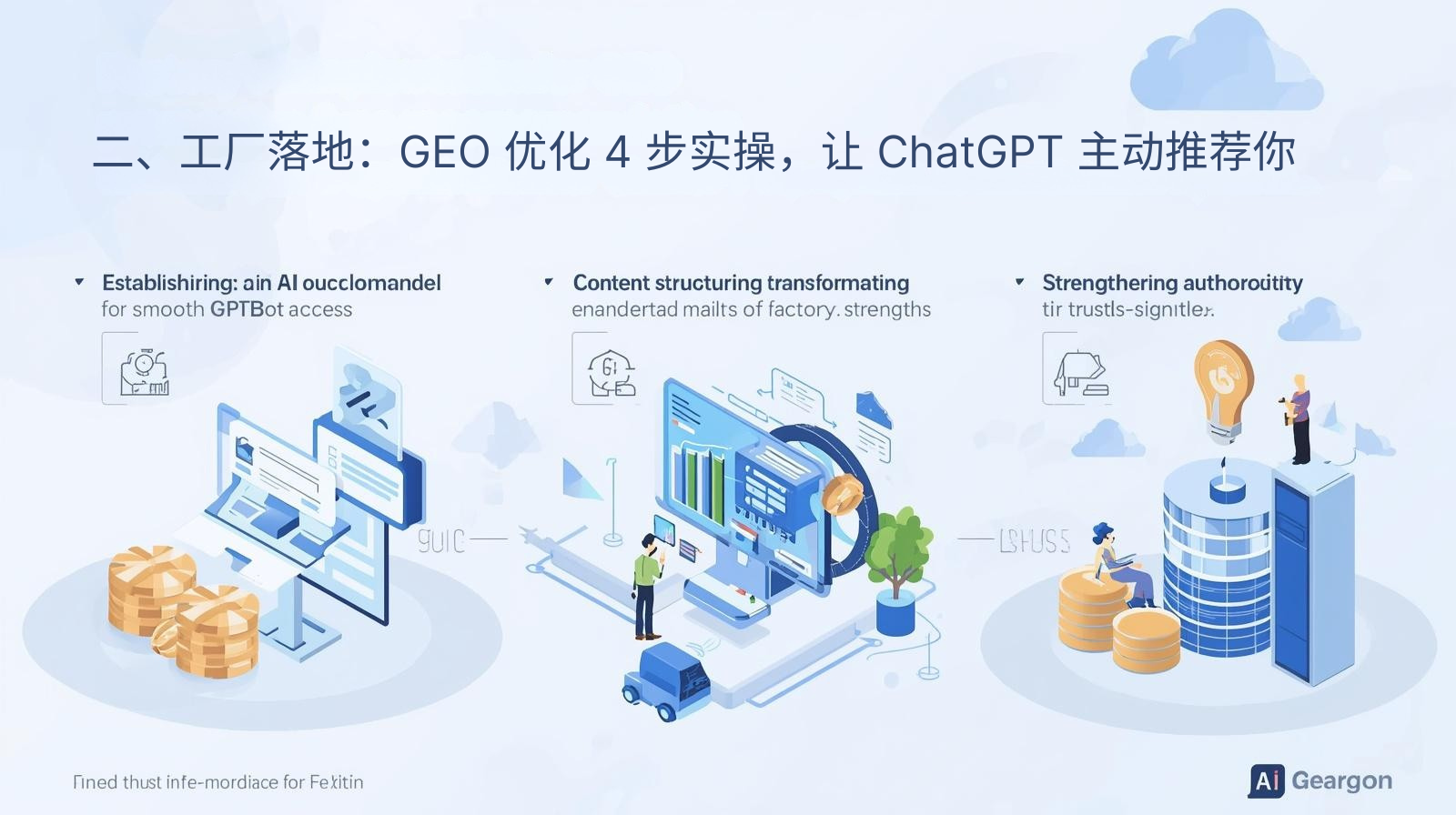
II. Factory Implementation: 4 Practical Steps to GEO Optimization, Encouraging ChatGPT to Recommend You
2.1 Establish an AI crawling channel to allow GPTBot to successfully access your site.
First, ensure that ChatGPT's crawler GPTBot can successfully access your independent website's content; this is the foundation for its recommendation. Key operational points include: allowing GPTBot to access core pages in your website's robots.txt rules, avoiding firewalls, IP blocking, and complex login barriers that hinder crawling; optimizing page speed with Google PageSpeed Insights, aiming for loading speeds under 2 seconds in Europe and America, as AI crawlers prefer smooth and stable sites (https://pagespeed.web.dev/ ); cleaning up broken links and error pages, ensuring that product pages, qualification pages, and factory introduction pages can be opened normally, improving the crawler's trustworthiness (https://www.screamingfrog.co.uk/seo-spider/ ).
2.2 Content structuring transformation enables AI to instantly understand your factory's capabilities.
AI cannot read and understand like humans; it only recognizes structured and standardized information. Factory websites must reconstruct content according to AI preferences. Product pages use a unified set of modules: product parameters, materials, MOQ, delivery time, certification number, and application scenarios, all presented in plain text to avoid placing key information in images or PDFs. Company pages highlight physical factory information: factory area, production capacity, number of equipment, years established, export countries, and actual photos of the workshop. Frequently asked questions (FAQs) are placed upfront, such as "Minimum order quantity," "Delivery time," "OEM/ODM support," and "Certifications available." This information will be directly extracted by ChatGPT to answer buyer questions. (https://blog.csdn.net/waderwang/article/details/152323810 )
2.3 Strengthen authoritative and trust signals so that AI dares to recommend you to customers.
In 2026, AI recommendation logic will heavily rely on verifiable and authoritative information. Factories need to move their offline qualifications online and provide verifiable documentation. Official, verifiable links should be added to CE, FDA, ISO, BSCI, and other certification pages to allow AI to cross-verify authenticity. Supplementing with real overseas customer case studies from the past two years, including country, purchased products, customized needs, and feedback, will enhance persuasiveness. Maintaining consistency in business profiles across independent websites, LinkedIn, and Google, including unified factory names, addresses, and contact information, will create a stable brand entity signal and improve AI trust ratings. (https://m.sohu.com/a/985507034_122637000/ )
2.4 Deploy semantically adapted content to accurately match procurement inquiries.
Create content based on common questions asked by buyers in your target market, rather than simply selling your products. Use tools like AnswerThePublic to uncover real questions from overseas buyers, and structure content around intent keywords such as "factory," "manufacturer," "custom," and "wholesale." Regularly publish factory updates, new product development, and industry solutions to maintain site activity; AI favors authoritative sites that are consistently updated. Avoid keyword stuffing; use natural paragraphs to express your advantages, such as "12-year-old metal stamping factory, EU CE certification, monthly production capacity of 5 million pieces, supports small-batch customization." Clear semantics make it easier for AI to match your content. (https://www.globalsir.com/geo-guide/ )
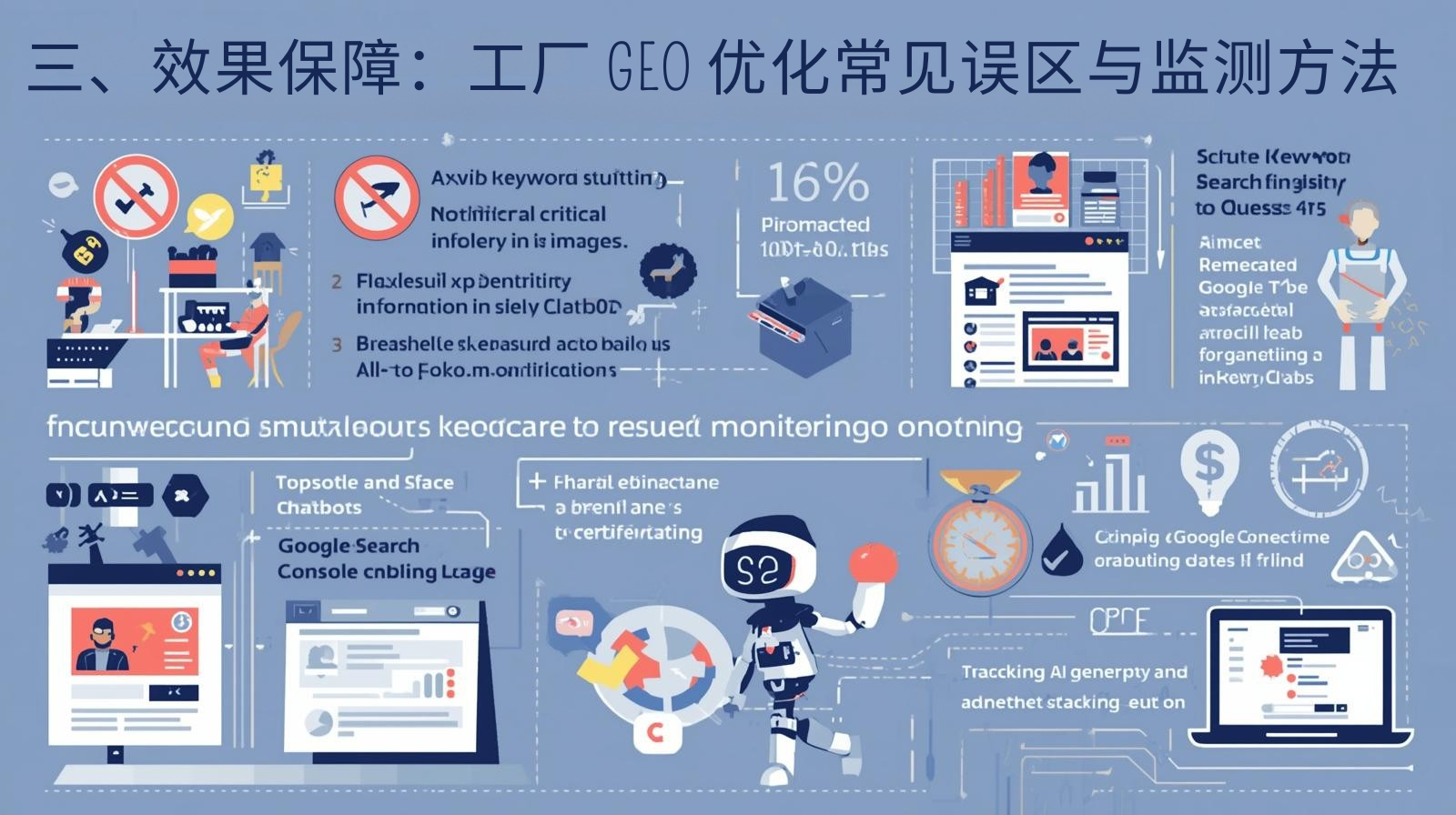
III. Guaranteeing Results: Common Misconceptions and Monitoring Methods for Factory GEO Optimization
3.1 Three GEO Misconceptions to Avoid in 2026
First, don't treat GEO like traditional SEO. Simply stuffing keywords is meaningless. AI values information structure and credibility, not keyword density. Second, don't put all your core qualifications, capacity, and parameters in images. GEOBot can't recognize text in images, which will directly prevent AI from extracting key information. Third, don't use fake certifications or fabricated cases. AI will verify information across sites, and if it finds inconsistencies, it will lower the trust rating and may even stop crawling the site altogether.
3.2 Simple and Implementable Methods for Monitoring Results
Enter core keywords into ChatGPT weekly to check if your factory name and independent website link appear; use Google Search Console to observe the crawling frequency and crawled pages of GPTBot to ensure that core pages are indexed correctly (https://search.google.com/search-console ); track inquiry sources, mark precise inquiries brought by AI dialogue, and compare the changes in quantity before and after optimization. Generally, you can see obvious results 15-30 days after standardized optimization (https://platform.openai.com/docs/guides/gptbot ).
Recommended Article: Your Competitors Haven't Reacted Yet: Building an Independent E-commerce Website with GEO is the Biggest Blue Ocean Strategy Right Now
Recommended Article: Your Competitors Haven't Reacted Yet: Building an Independent E-commerce Website with GEO is the Biggest Blue Ocean Strategy Right Now
In the AI era, independent factory stations (GEOs) are a must.
In 2026, foreign trade customer acquisition has entered the era of AI recommendations. The way buyers find factories has changed, and your customer acquisition methods must change accordingly. GEO is not an option, but a basic configuration for a factory's independent website. It can transform your production capacity, qualifications, and factory strength into AI-identifiable, shareable, and recommendable digital assets, turning ChatGPT into your 24/7 online sales platform, continuously helping you connect with precise overseas buyers.
For GEO optimization to be fast and stable, the underlying independent website architecture is crucial. PinDian Technology boasts over ten years of experience building websites for foreign trade factories, serving over 7000 clients. Utilizing React technology, their websites offer a smoother loading experience, faster global access speeds, and a structure more compatible with AI crawlers. From the ground up, their design supports the structured layout, high-speed loading, and crawler-friendly rules required for GEO optimization, making your factory website inherently easier for ChatGPT to recognize and recommend. Whether you're building a new factory website or upgrading an existing one, PinDian provides an integrated website building and GEO optimization solution, helping you seize the AI traffic opportunity and easily obtain stable, high-quality overseas inquiries.